

The thinking method history’s most productive minds actually used
Da Vinci, Darwin, Edison, and Einstein didn’t take notes the way you were taught. Here’s what they were doing instead.

Hi Kwik Brain,
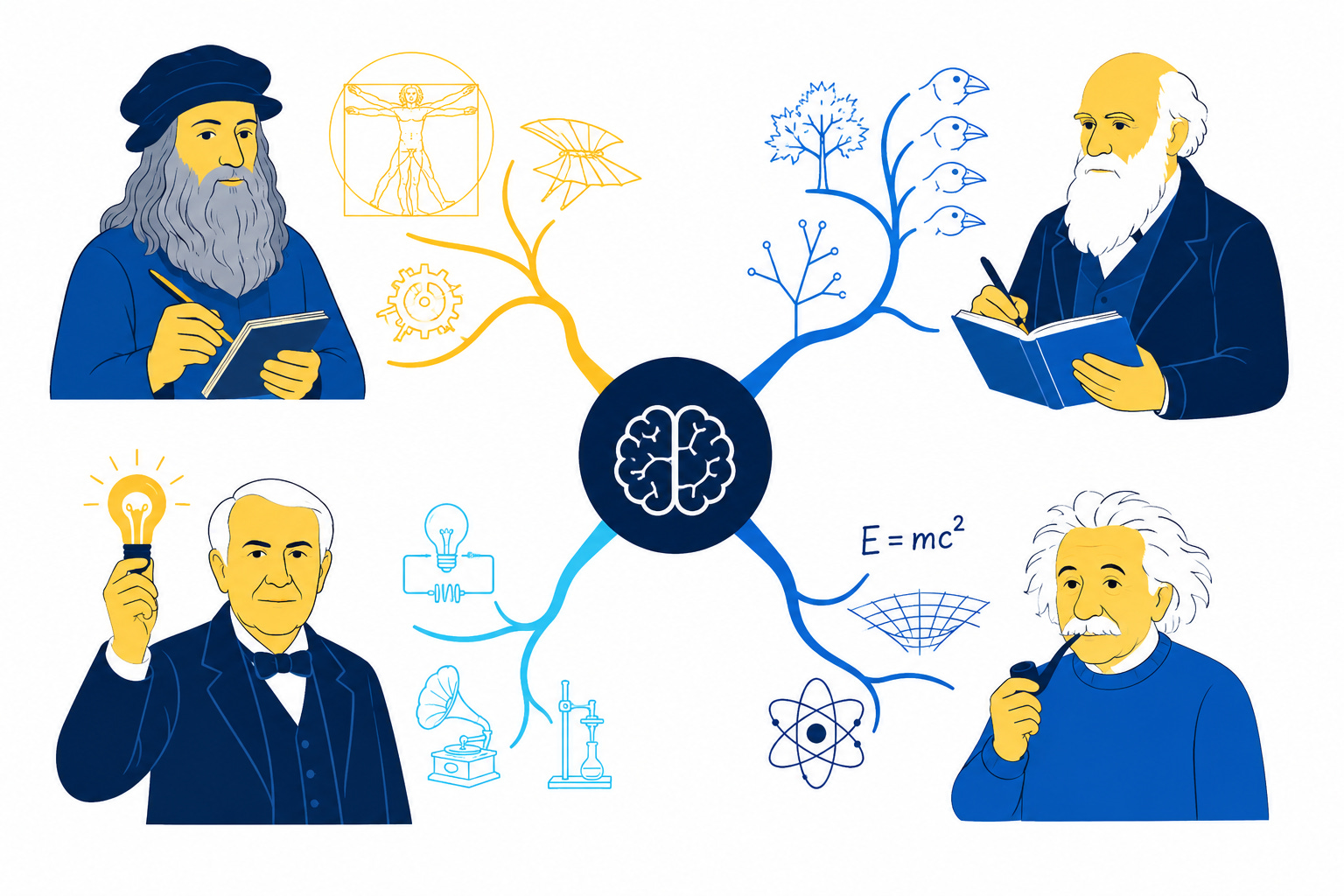
Da Vinci’s notebooks don’t read like notes. Neither do Darwin’s or Edison’s.
All four of these figures, da Vinci, Darwin, Edison, and Einstein, relied on visual, non-linear formats in their working notes: keywords, images, and associative diagrams rather than sequential prose. This wasn’t a quirk, it was a method, and modern neuroscience explains exactly why it outperformed anything else they could have used.
Tony Buzan formalized the approach in the 1960s, frustrated that rewriting linear notes was producing less understanding in his college courses, not more. His 1974 BBC series Use Your Head brought it to mainstream audiences, followed by his 1993 bestseller The Mind Map Book. He called it mind mapping.
Why linear notes work against you
The brain doesn’t store information in lists. It stores it as an interconnected web: when you encounter a new idea, neurons fire and connect it to existing memories, emotions, and sensory experiences simultaneously. Linear note-taking imposes a sequential format on a non-sequential system.
The cost is measurable. Traditional notes activate primarily the left hemisphere, covering language, logic, and sequence. Visual-spatial processing, pattern recognition, and broad pattern thinking stay offline. You’re encoding with half a brain.
What shifts when you map instead
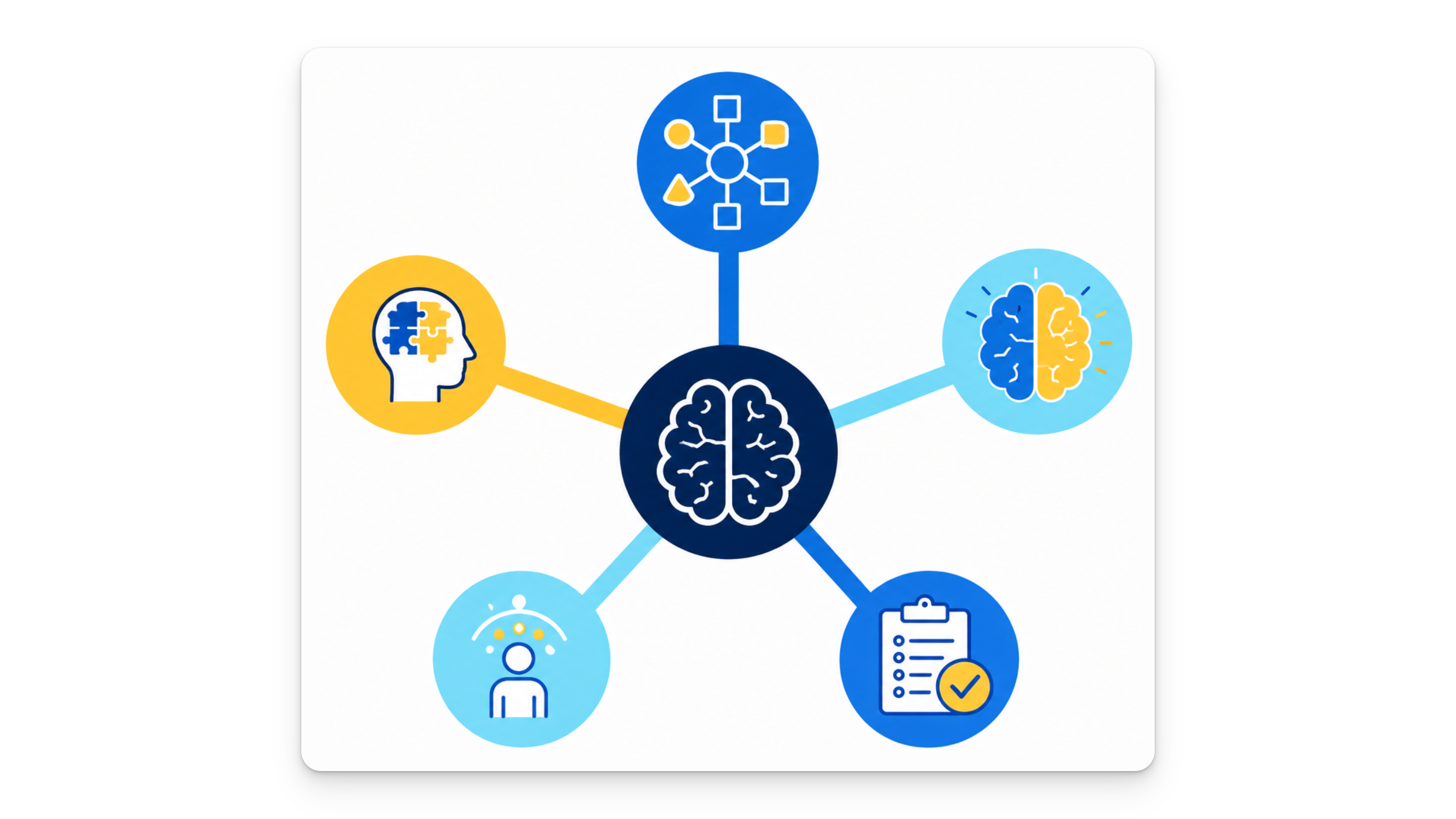
Three mechanisms account for the difference.
Schema activation. Schemas are knowledge structures in long-term memory that let the brain categorize and retrieve related information rapidly. Research published in Nature Communications (2022) found that schemas accelerate memory consolidation by serving as a scaffold for new information. Mind mapping forces you to identify how concepts connect to each other, which is the exact process that triggers schema formation and durable encoding.
Bilateral engagement. Adding colors, images, and spatial structure pulls right-hemisphere processing online alongside left-hemisphere analysis. The result is richer memory traces: the same information becomes retrievable through multiple pathways, not just one.
Cognitive load reduction. Working memory holds approximately 5 to 9 items at a time. Complex relational thinking overloads it. Mind mapping externalizes that load onto paper or a screen, freeing capacity for synthesis and understanding rather than just tracking.
The evidence behind it
Scientific studies consistently show a 10 to 15% improvement in retention when using mind maps versus conventional note-taking. In one controlled study, the mind-mapping group outperformed the control group on long-term memory tests even though their motivation to use the assigned technique was lower. Researchers noted that higher motivation would likely produce even stronger results.
The meta-analyses are more striking. A 2024 review of 22 studies and 1,535 participants found an overall effect size of g = 0.73 on critical thinking. For interventions lasting 4 to 12 weeks, that effect climbed to g = 1.54. Collaborative mind mapping produced g = 1.53, making it one of the most effective team thinking methods documented in the research. A separate 2022 analysis of 21 studies found consistent advantages over traditional instruction, with STEM subjects seeing the greatest gains.
These aren’t marginal improvements. They’re the kind of effect sizes researchers make careers out of.
How to actually do it
Most people who tried mind mapping and quit were never using it correctly. The single most common error is writing full sentences instead of keywords. Full sentences recreate the same passive processing as linear notes, and distilling each idea to a single word or short phrase forces the brain to reconstruct meaning during review, which is where deep encoding actually happens.
Buzan’s original rules, the ones the research validates:
Place your central topic in the middle, as an image or bold keyword
Use one keyword per branch, not phrases or sentences
Radiate four to seven main branches outward
Apply one color per main branch and its sub-branches
Add images or symbols at the center and on key branches
Draw cross-links between ideas on different branches
That last step is where the most valuable thinking happens. Most people skip it.
Build the first draft fast, without filtering. Then review it immediately, and return to it at increasing intervals. A map reviewed repeatedly encodes far more than one made once and filed away.
The method behind the genius
Da Vinci didn’t fill his notebooks with diagrams because it looked impressive. He did it because it matched how his mind worked.
Your mind works the same way. The branching structure, the colors, the keyword density. These aren’t stylistic choices. They mirror how memory encodes information, how retrieval works, and how one thought leads to the next.
If you want to go deeper on the learning methods that compound over time, the Kwik Brain course library is at kwikbrain.com/pages/courses.
A list has a beginning and an end. A mind map has a center, and it expands in every direction. One records what you already know. The other reveals what you didn’t know you knew.
Bonus reading
The history and science of mind mapping Traces the method from its roots in the 3rd century through Tony Buzan’s formalization and the research that followed.
Effects of schema on brain connectivity and durable memory The Scientific Reports (2023) paper showing how prefrontal-hippocampal connectivity after schema-consistent learning predicts long-term memory performance.
Enhancing creative and critical thinking through mind mapping Reviews the evidence for mind mapping’s effect on divergent thinking and creative output.
Yes, makes a big difference!
Very helpful. I am going to try this now :)