

Your to-do list is not a memory device
Why writing it down only works when you actually mean it

Hi Kwik Brain,
I have written “sort out the insurance thing” on a list. Wrote it, looked at it, felt nothing. The task sat there for weeks and tugged at me the entire time.
By the end of this you will know why that happens, and what to write instead so the tugging stops. There is a real mechanism underneath it. There is also a very popular explanation for it that turns out to be wrong.
What almost everyone gets wrong about unfinished tasks
You have heard that your brain remembers unfinished tasks better than finished ones. It has a name, the Zeigarnik effect, and it is the reason people tell you to dump everything onto paper. Get it out of your head so your memory can stop carrying it.
Lovely theory. It does not survive contact with the data.
A 2025 meta-analysis from the University of Bern pooled 59 publications on the effect. The recall ratio for interrupted tasks against completed ones landed at 0.99, and unfinished tasks made up 49.16% of everything people remembered. Slightly less than the finished ones. Where researchers could compute an effect size at all, the average was dz = 0.15, small enough to be noise.
Your brain does not file unfinished work in bold.
Something else in that same analysis did survive. When people got the chance to return to an interrupted task, they returned 67% of the time against a 50% chance baseline. The pull back toward unfinished work is real and it is general.
Open loops do not sit quietly. They reach.
What that reaching costs you
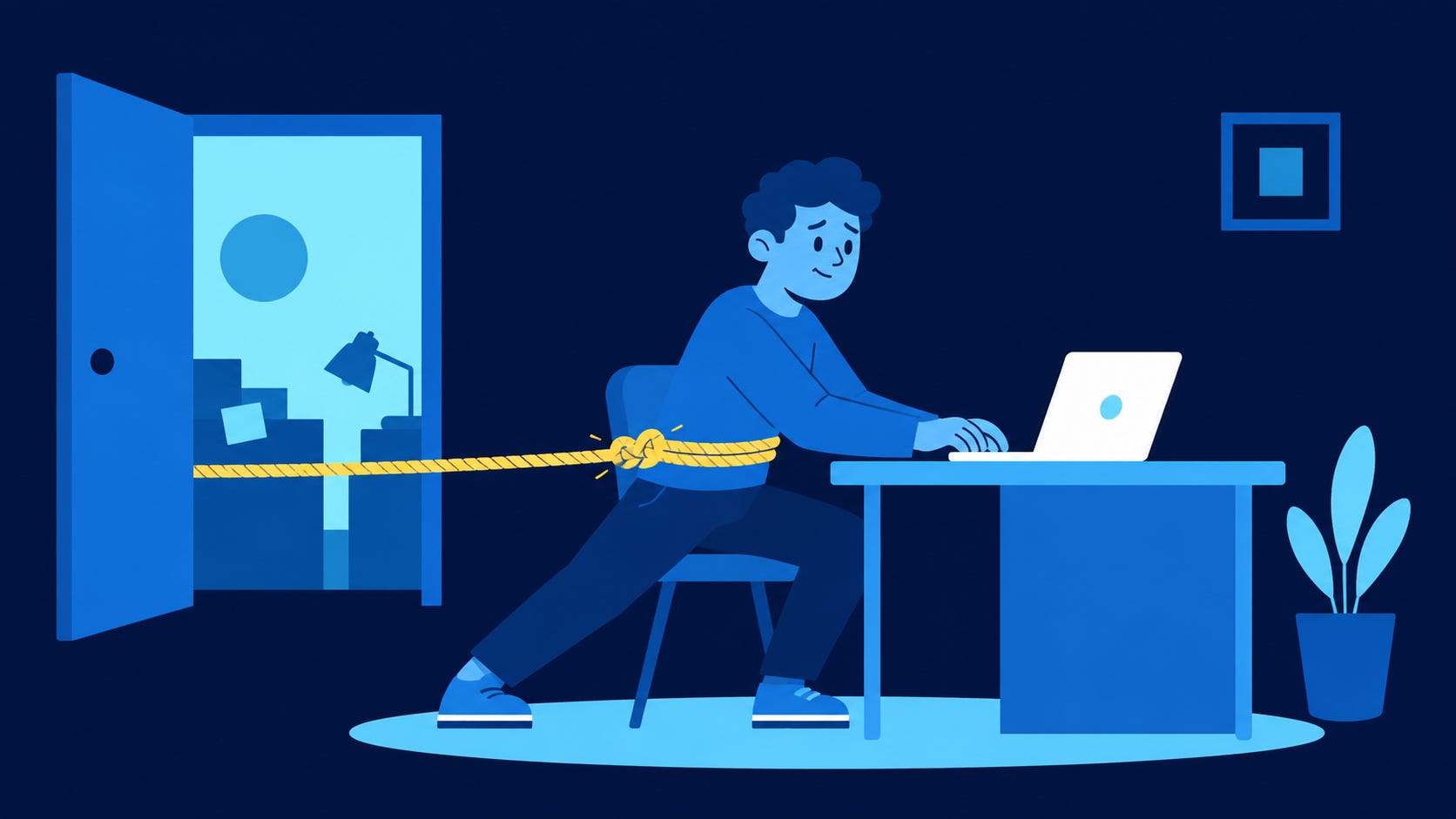
Sophie Leroy gave this a name: attention residue. You stop task A, you start task B, and part of your attention stays behind. You are sitting in front of the new thing with less of your mind available for it.
Her experiments turned up something most productivity advice skips. Finishing task A was not enough on its own. People who wrapped up in a relaxed, unhurried way carried residue anyway, still chewing on how they had done.
Meanwhile the interruptions keep landing. Researchers who shadowed information workers across more than 700 hours clocked an average of 11 minutes and 4 seconds on a piece of work before a switch, 57% of those work stretches interrupted, and around 25 minutes to get back to what they had been doing.
Time on any single screen has collapsed alongside it. 150 seconds in 2004, 47 seconds in recent years, median of 40.
Here is the part that reframes the whole problem. When people get interrupted, they finish the work faster, not slower. They compensate. The bill arrives as stress, frustration, time pressure and effort.
Speed was never what you were losing.
Why writing it down works, and why yours might not be
Two psychologists ran a series of studies on unfulfilled goals. People carrying one had intrusive thoughts pushing into an unrelated reading task. Goal-related words became easier to reach. Performance on an unrelated anagram task dropped.
Then they let participants write a specific plan for the goal. Every one of those effects vanished. The goal was still unfinished. Nothing had been done about it.
Writing the plan was the entire intervention.
Now the finding that changes how you should treat your own list. The effect was mediated by how earnest the plan was. Participants who went on to execute their plans were the ones who showed no interference. A plan written without meaning it did nothing at all.
Your brain is not reading your handwriting. It is checking whether you intend to do this.
Write the next action, not the topic
A vague line leaves the loop open because there is nothing in it your brain can act on. A specific plan names when, where, or how, which gives the goal somewhere to go and a reason to stand down until then.
Handle insurance becomes Call the claims line Tuesday at 2, ask about the deductible
Follow up with Dana becomes Text Dana tonight after dinner about the Thursday slot
Work on the deck becomes Draft slides 4 through 7 at 9am at the kitchen table
Book the dentist becomes Book the dentist from the parking lot before I drive home
The first version names a topic. The second makes an appointment, and your brain can tell which one you meant.
The 60 second version for when you get interrupted
You cannot finish everything before the next interruption arrives. In a survey of 202 working professionals, 40% reported more than ten interruptions a day and 15% reported more than twenty.
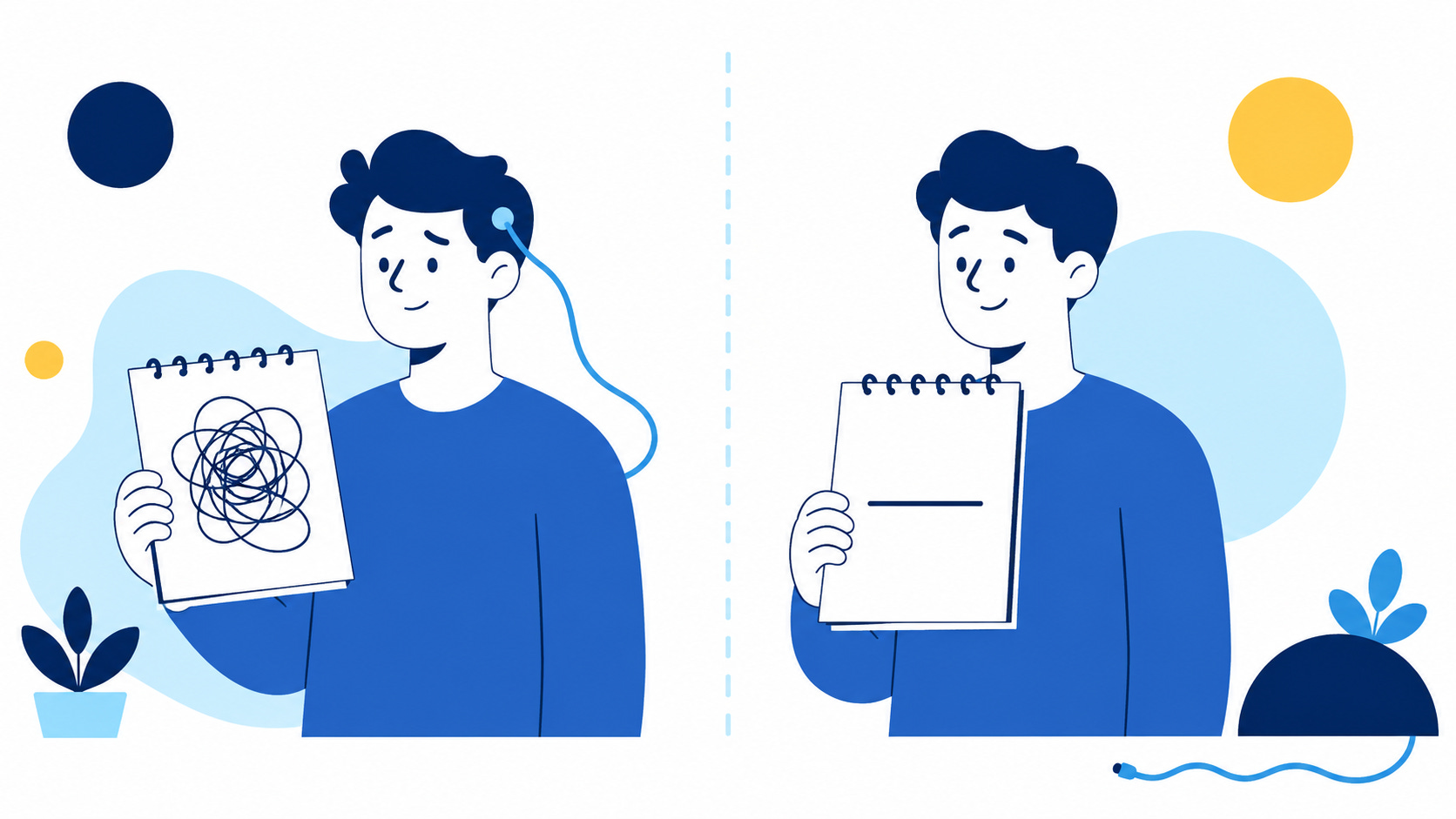
So there is a smaller move built for the middle of the mess. Leroy and Glomb tested it across four studies and called it a ready to resume plan.
Before you turn toward the interruption, spend under a minute writing where you left off, where you will pick back up, what is still hard about it, and what you are putting down for now.
Residue drops and performance on the thing you switched to holds up. Under a minute of writing protects the quality of everything that comes next.
Why open loops follow you to bed
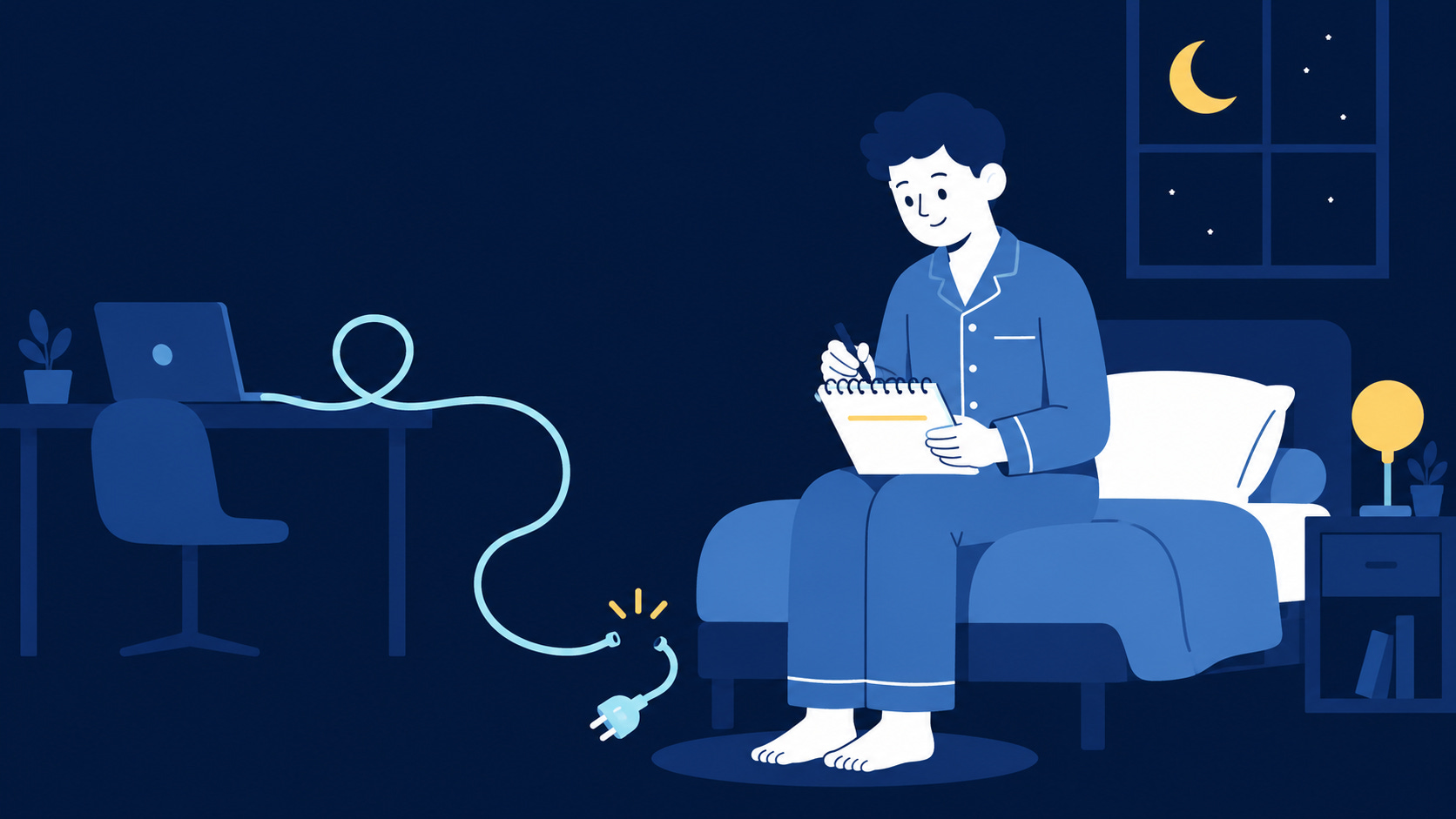
A meta-analysis covering 38,124 employees found that poor psychological detachment from work tracks with exhaustion, a higher need for recovery, and worse sleep quality. Detachment means the absence of work thoughts during off hours.
An open loop does not clock out at six. It comes home and sits down at dinner, still reaching.
Closing the day well means writing tomorrow’s first specific action before the laptop shuts. Not a list of everything. One line you mean.
The experiment we broke
The Bern researchers closed their paper with a line I keep returning to. They suggested the Zeigarnik effect is hard to reproduce today partly because modern participants cannot get absorbed enough in a task for the tension to build in the first place. Notifications, email and constant switching have eaten the very absorption the effect depended on.
We fragmented attention so thoroughly that we broke the experiment designed to measure unfinished work.
Whatever you wrote on your list this morning, your brain already knows whether you meant it.
love it, Jim! I would appreciate any insight for children! I have two great kids-11 and 8, but they are like me- interested in many things and easily distracted! I am working on external reminders for us all-clocks everywhere, timers, alarms.. but I need something else to help them remember all that needs done. Im not sure if an electronic organizer would help, or if paper would be better. RE digital fatigue, EMF, etc. of course, we have a daily schedule (that is changing a fair bit now in the summer with various camps, etc) V a more regular schedule when they go to school. Even that will change with different obligations-church, youth group, trips, sports, etc etc!! Thank you for all you do, my friend. Appreciate you
Great article! I really like the hack of spending a minute writing where you left off and where you will pick back up before moving on to another task.