

Your morning routine keeps dying. Here’s how to bring it back.
Three breakdowns, three fixes, two minutes each

Alexis and I run our annual gathering, Limitless Live, on September 11th and 12th just outside New York City, with Dave Asprey, Steven Kotler and Hal Elrod on stage. Go to limitlesslive.com and use the code LIMITLESSDAILY for a birthday discount.
Hi Kwik Brain,
Most morning routines don’t die from a lack of discipline. They die on an ordinary Tuesday, and nobody can say why.
You had a good first three days. Then one morning you looked up and it was 10 a.m. and the sequence hadn’t happened, and the honest explanation was that you couldn’t remember deciding to skip it.
By the end of this you’ll be able to name which of three breakdowns is running, and correct it before tomorrow morning. No new steps, no new acronym. This is repair work on a sequence you already have.
If you haven’t got the sequence yet, start there. Everything below assumes you already do.
Your morning is not a blank slate
Waking up isn’t a switch. Alertness and mental performance stay measurably impaired for a stretch after you open your eyes, and that impairment runs longer after short sleep or an early alarm.
So the first minutes after your alarm are not when your willpower is strongest. They’re when it’s weakest. Later in the morning is a different story, and for plenty of people that’s their sharpest window of the whole day. The problem is the gap between the alarm and that window, because whatever arrives in it tends to own everything after.
That’s the piece most people miss. They design their morning for the version of themselves who shows up at 11 a.m. with two coffees in, then treat the collapse as a character problem.
It isn’t. It’s a predictable breakdown with three common causes.
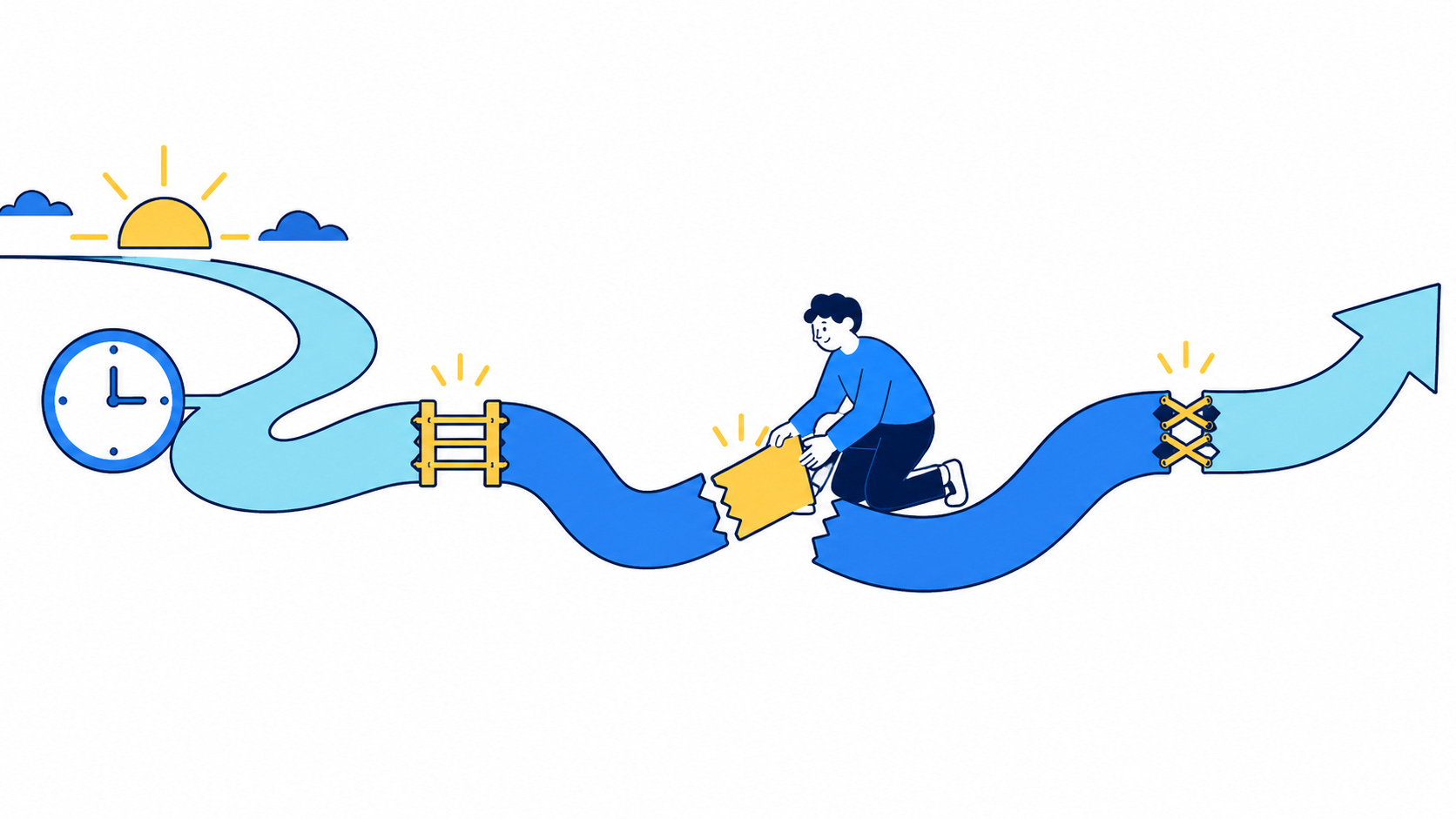
Something got to you first
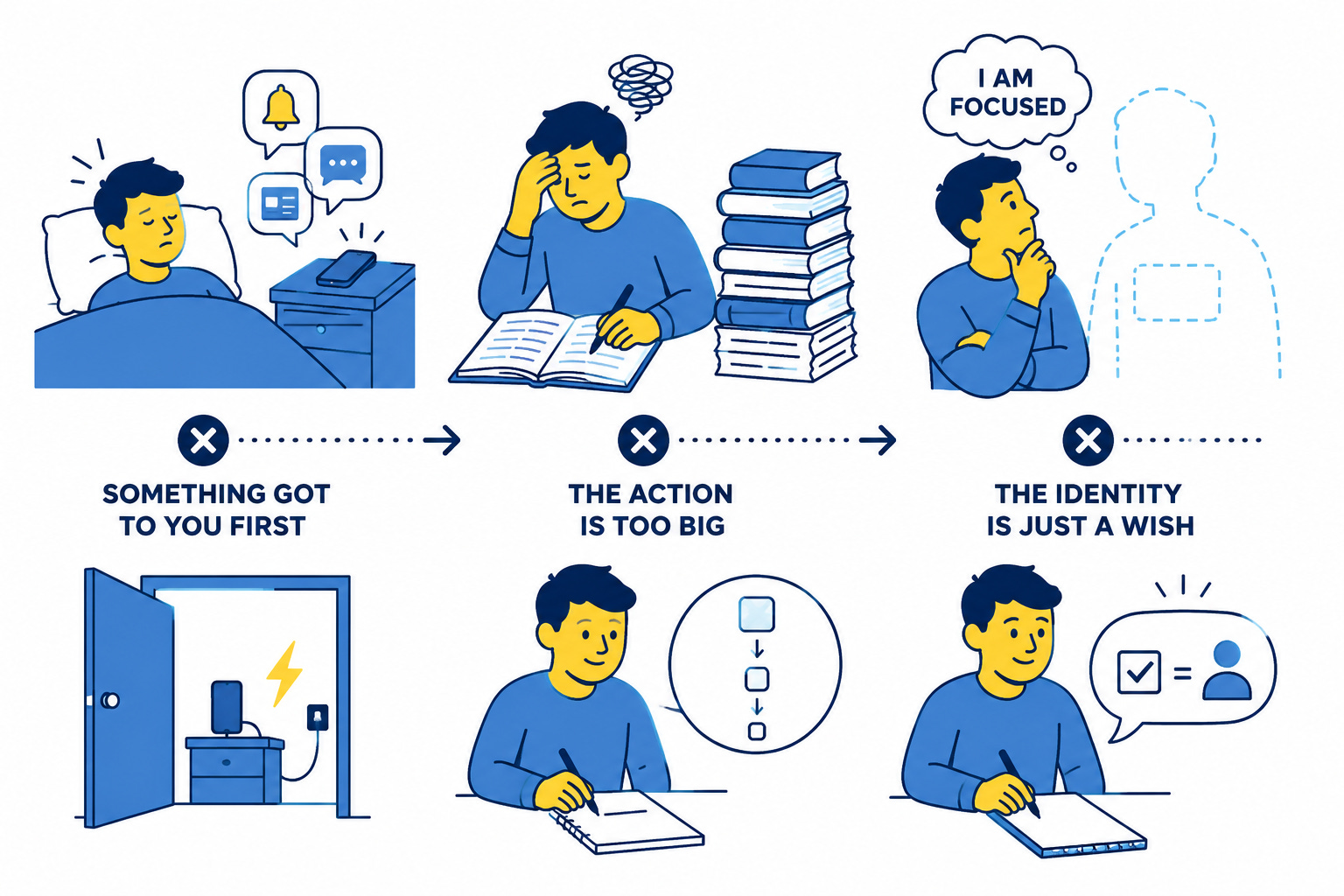
You’ll know because by mid-morning you can’t remember the idea you were supposed to be carrying. A headline got you, or a message, or just the screen.
This one has the hardest evidence behind it. Researchers at UT Austin found that a phone within reach reduces your available mental capacity even when it’s powered off and face down. The people who left it in another room beat the people who kept it in a pocket.
So “put your phone away” fails as a rule. Pocket is nearby. Nightstand is nearby. Face down on the counter is nearby.
Fix it like this: the phone charges in a different room than the one you sleep in, and stays there until you’re done. If the alarm is the problem, buy a clock.
The action is too big
You’ll know because you skip on your hardest days, and only your hardest days. A sequence that runs on easy mornings isn’t a habit yet. It’s a mood.
Motivation isn’t what’s failing here. Ability is. On a demanding morning your motivation is unreliable by definition, so the only thing keeping the behavior alive is being small enough not to need it.
One study found that a small task attached to dismissing the alarm helped people wake more fully and start sooner. The tiny bridge beat the ambitious one.
Fix it like this: halve the action. Then halve it again. Keep cutting until the only way left to fail is refusing to start. One sentence, not one page. You can grow it back once it survives a bad week.
The identity is just a wish
You’ll know because the doing part feels negotiable, like you talk yourself into it every morning.
Your “I am” statement has nothing underneath it. People whose behavior matches how they already see themselves run on far less friction, but only when there’s proof behind the identity. Said once and never demonstrated, it just sits there.
Straight with you, this is the thinnest evidence of the three, and it’s correlational. Check it last.
Fix it like this: rewrite the statement so it can only be true if today’s small action happened. Not “I am focused.” Try “I am someone who writes the first line before anything else gets my attention.” Now the action is the proof.
The two-minute diagnostic
The moment you notice drift, run these three. Yes or no, no journaling.
Did anything from outside reach me before I started?
Can I point to one thing from yesterday that proves my identity statement?
Up. Was my action doable in under sixty seconds, with zero setup?
A no on the first question means something got to you first. A no on the third means your action is too big. A no on the second means the identity has no proof yet. Check them in that order, because the first and third break most mornings.
The rule that makes the repair automatic
Noticing the failure and correcting it are separate problems. The correction has to be decided in advance or it becomes one more decision made at your least capable hour.
If-then plans close the gap between intending something and doing it, because they hand the cue and the response over as a pair instead of leaving you to work it out live. Write one for each of the three. Once.
If the phone is in the bedroom when I wake, then it goes to the kitchen before anything else.
If I skipped yesterday, then today’s action gets cut in half.
If I can’t name yesterday’s evidence, then I rewrite the statement before I do anything else.
Three sentences. Written down, not remembered.
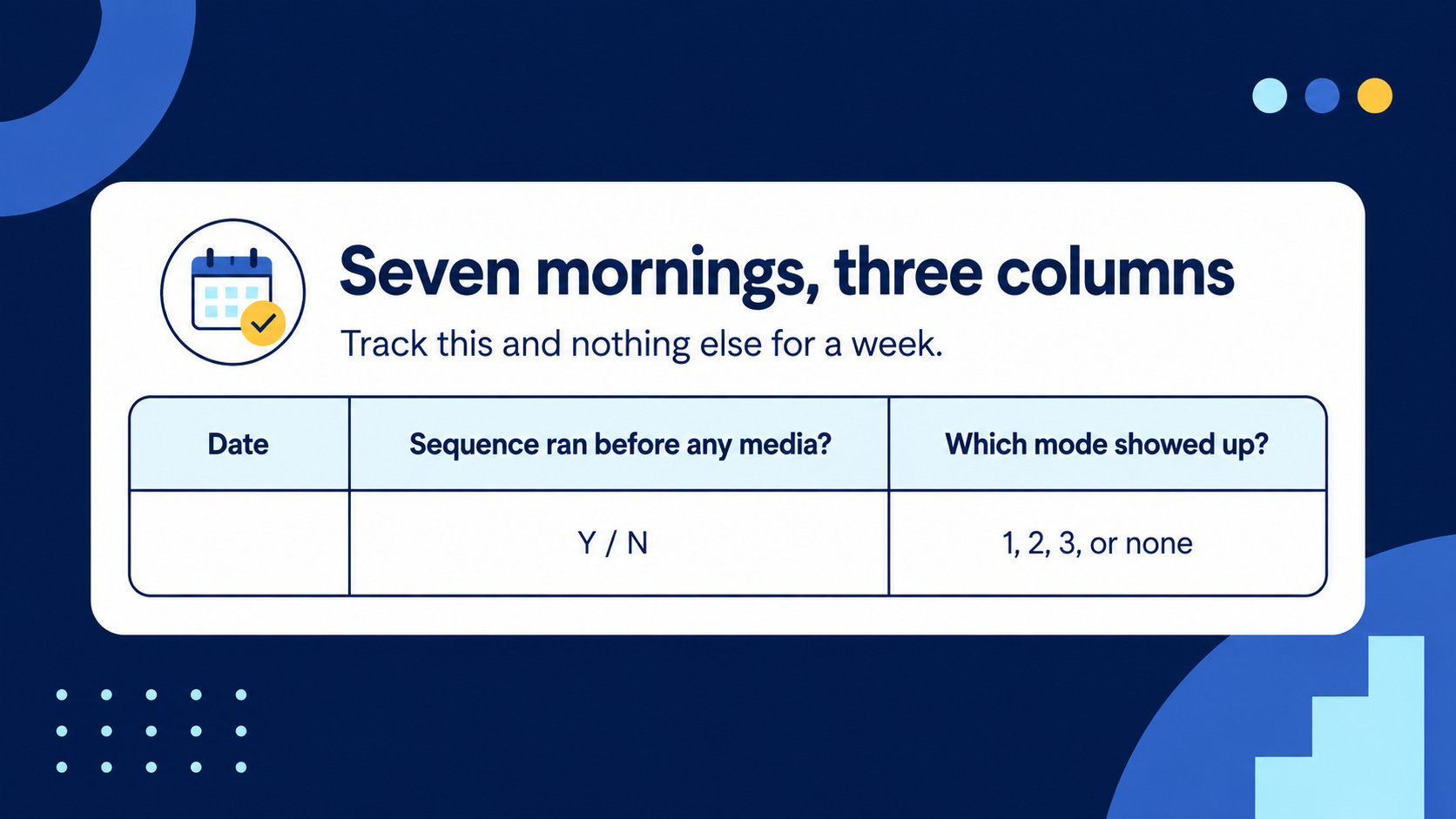
After seven days you'll see your pattern without having to analyze anything. Most people find one of the three accounts for nearly all their misses, and they were guessing wrong about which one.
Alexis and I run our annual gathering, Limitless Live, on September 11th and 12th just outside New York City. Go to limitlesslive.com and use the code LIMITLESSDAILY for a birthday discount.
A perfect morning is a nice thing to have and a terrible thing to depend on. The sequence that’s still running in October won’t be the one that never broke. It’ll be the one you could fix in two minutes, on a Tuesday, when nothing was going your way.
Interestingly - I find willpower highest in the morning, disapating towards end of the day. Always appreciate your content!
Awesome article! Could you please write on energy drainage due to emotional things and stimulation.