

Your brain solves problems better when you walk away
The counterintuitive science of why your best ideas hit in the shower

Forwarded this newsletter? Become a Kwik Brain
Hey Kwik Brain,
In today’s newsletter, you’ll discover why grinding harder at your desk actually blocks your best ideas, and learn the exact strategies to turn showers, walks, and breaks into your most productive thinking time.
Your desk is lying to you. That feeling of progress when you stare at a problem for hours? It’s often the opposite. The breakthrough you’re chasing shows up when you give up and step into the shower.
This isn’t luck. It’s neuroscience.
Why the shower beats your desk
When you do something automatic and low-effort, your brain shifts from task-focused control to the default mode network (DMN). This system activates when attention turns inward and the mind wanders.
The DMN integrates memories, emotions, and abstract concepts. It lights up during spontaneous thought, daydreaming, and the kind of mental wandering that most workplaces punish.
Here’s what makes this matter: highly creative thinkers show greater functional connectivity between the DMN and executive control regions. Good ideas emerge when loose associative thinking interacts with more deliberate evaluation systems.
Your shower provides just enough external structure to keep you relaxed while freeing the DMN to explore connections your focused desk work couldn’t make.
Contrast this with your desk. Sitting there under pressure engages the brain’s executive control network, optimized for rule-following and working memory. But it gets stuck in rigid patterns, especially under stress. You keep re-running the same unproductive strategies instead of discovering a new angle.
The incubation effect is real
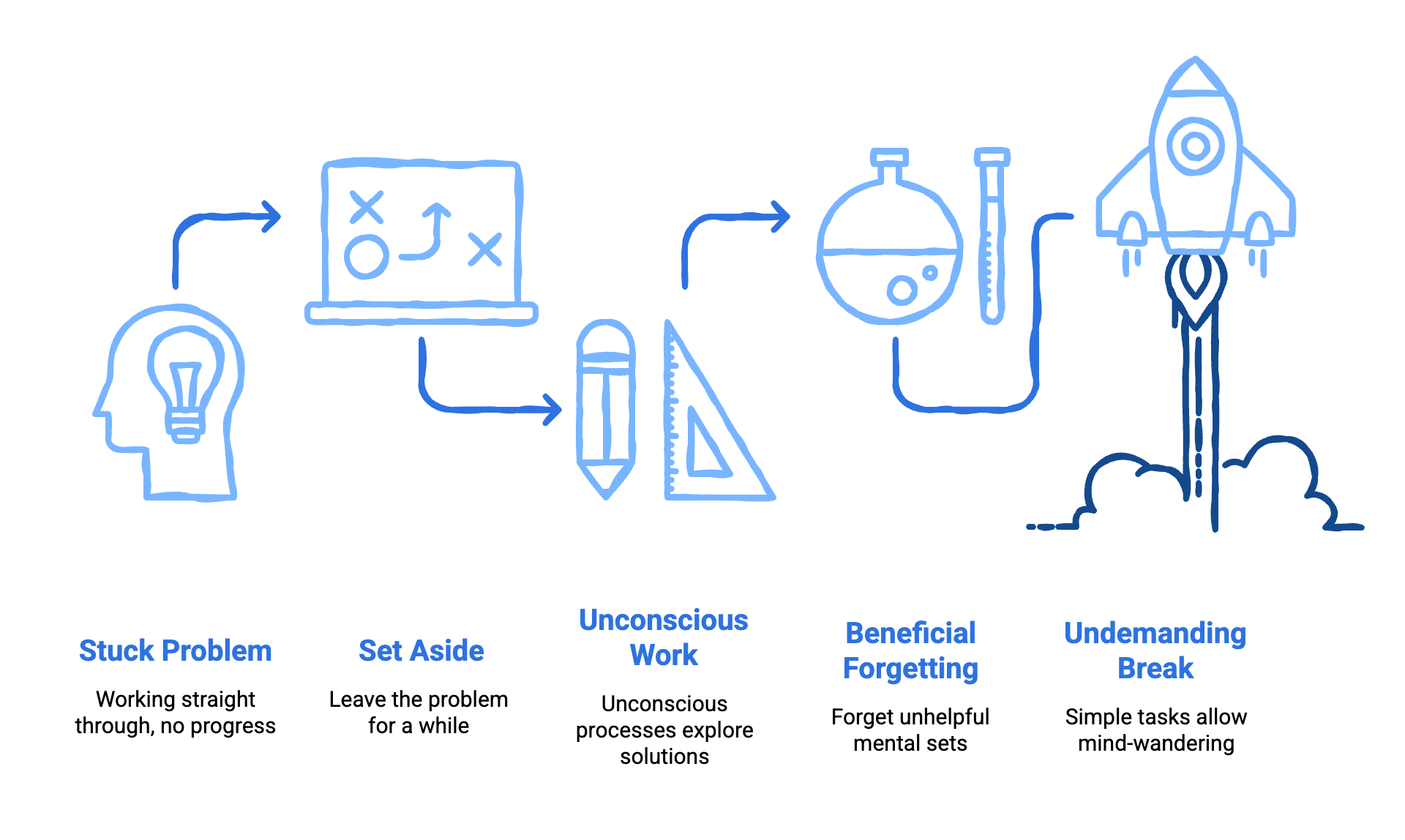
“Incubation” isn’t just a feeling. It’s a robust finding in creativity research: performance on a problem improves after you leave it aside for a while, compared to working straight through.
A meta-analysis reviewing over 100 experiments reported a reliable positive effect of delayed incubation on creative problem solving. People do better on insight problems if they first try, get stuck, then take a break before coming back.
Several mechanisms drive this:
Unconscious work. When a problem is set aside, unconscious processes continue exploring solution paths, which later surface as sudden insights.
Beneficial forgetting. Incubation helps you forget unhelpful mental sets or fixations. When you return, you’re less anchored to the wrong approach.
The right kind of break matters. Undemanding activities during the break, simple tasks that allow mild mind-wandering, produce stronger incubation benefits than highly demanding tasks or no task at all.
This is exactly the profile of showering, walking, or doing light chores: they occupy the body just enough to keep you out of ruminative loops while leaving mental bandwidth for background recombination.
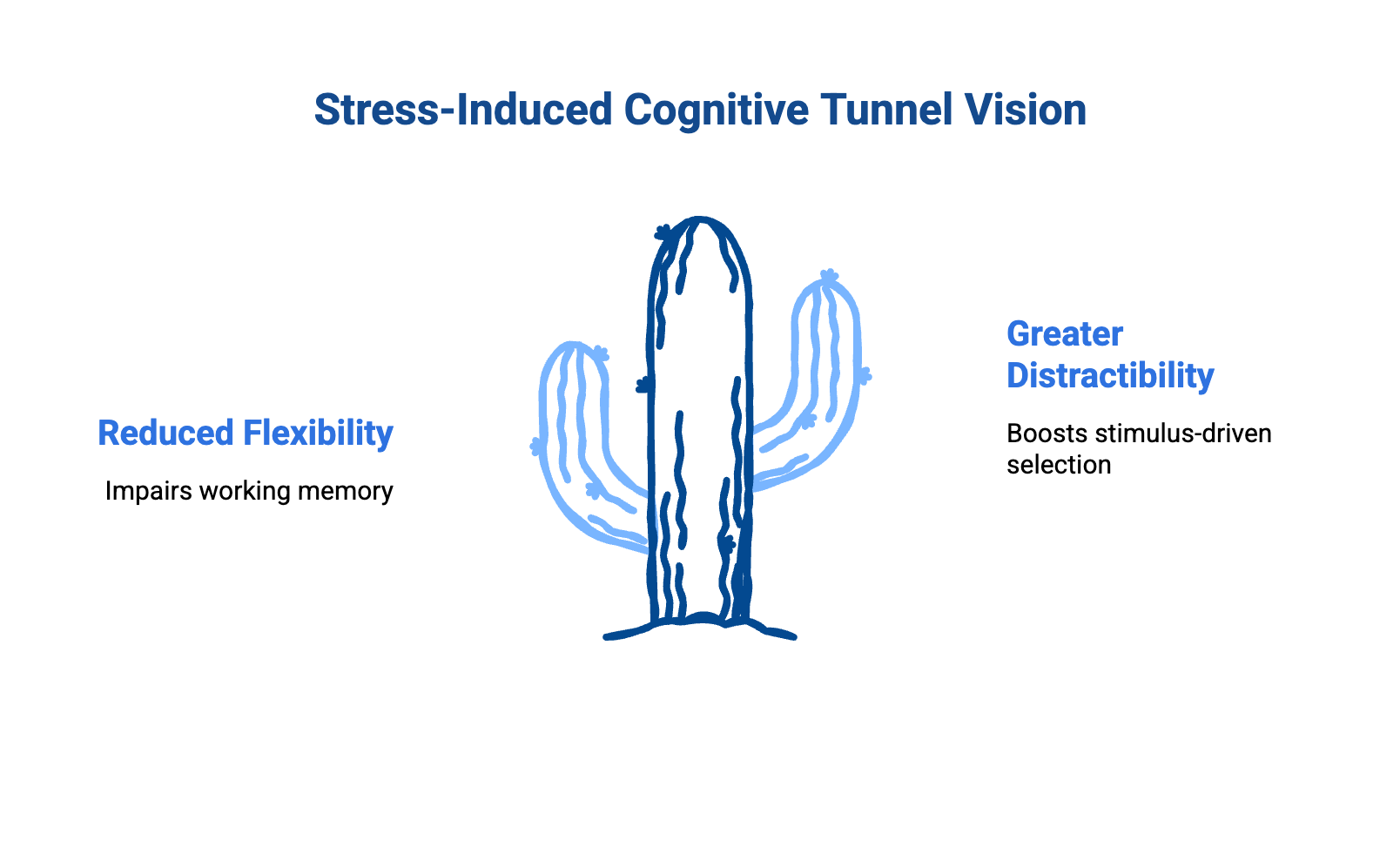
Stress creates cognitive tunnel vision
When you’re grinding at your desk under pressure, elevated stress and cortisol make your mental spotlight too tight.
Under stress, your body releases cortisol and adrenaline, shifting you into a threat-oriented state where attention narrows around perceived danger cues. Modern experiments confirm that people under threat lock onto the source of danger and process less of the broader context.
The consequences for thinking:
Reduced flexibility. Stress impairs working memory and cognitive flexibility, the very functions needed to hold multiple possibilities in mind and switch strategies.
Greater distractibility. Acute stress impairs goal-driven attention and boosts stimulus-driven selection, leading to greater distractibility by salient but irrelevant cues.
Threat signals, whether consciously noticed or not, systematically narrow both perceptual and conceptual attention, while benign cues broaden it.
“I have to solve this now” is often the exact mindset that prevents you from solving it at all.
Your action plan: engineer better breaks
You can structure your work so that shower thoughts become a repeatable tool rather than a happy accident.
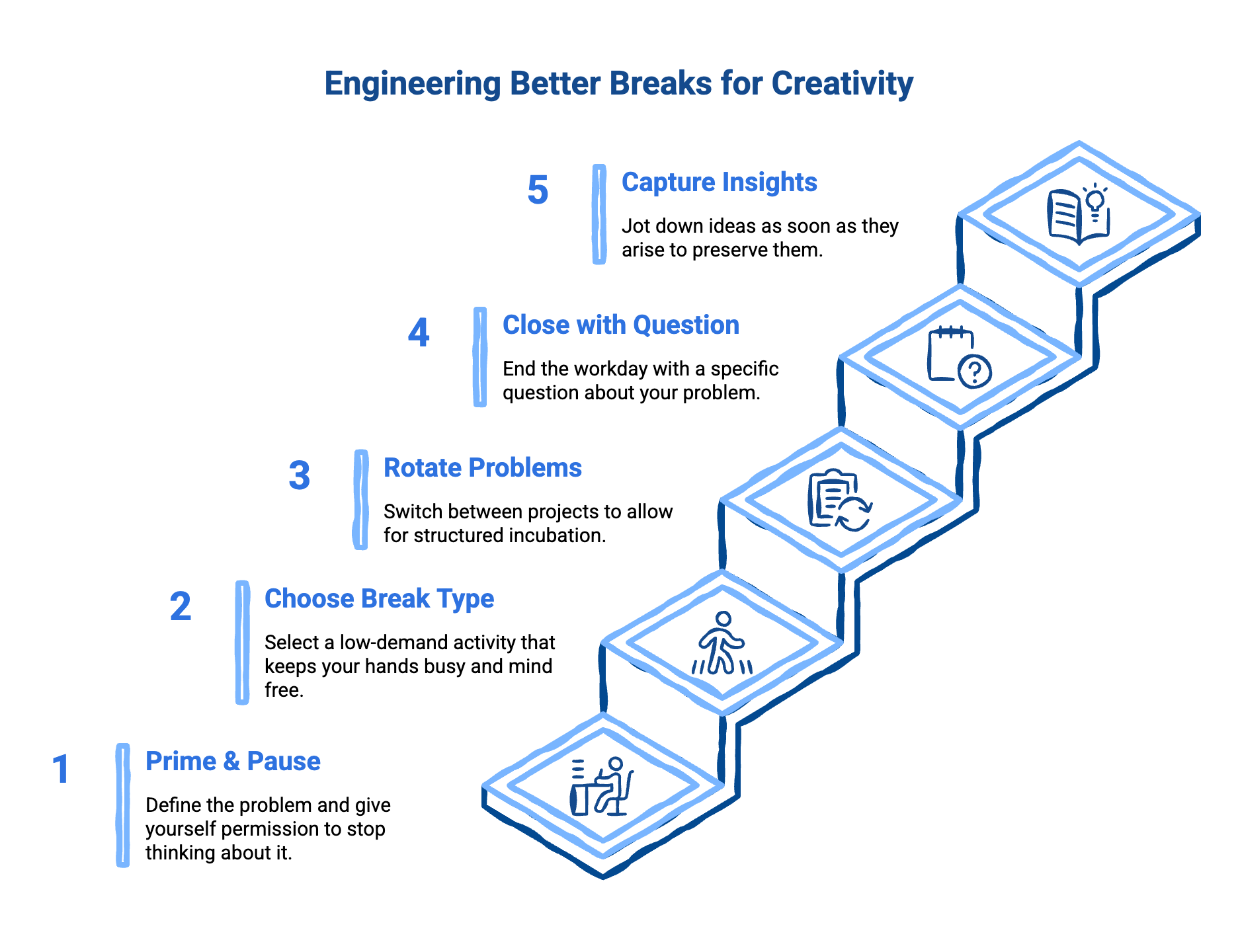
Prime, then pause
Before stepping away, clearly define the problem in a sentence or two. Review what you’ve tried so far. This preparatory activity increases incubation benefits.
Then explicitly give yourself permission not to think about it. If it pops up, note it and gently return attention to the simple activity.
Choose the right kind of break
Good options: walking a familiar route, stretching, making tea, washing dishes, anything that keeps your hands busy and mind free to wander.
Avoid high-demand or high-stimulus breaks. Scrolling social media or diving into email loads working memory and bombards you with new stimuli, reducing incubation gains.
Rotate problems
Keep 2-3 projects in different stages. When you hit an impasse on one, switch to another instead of forcing progress. This gives the first a structured incubation period.
Close with a question
At the end of each workday, write down one specific question about your current problem. Many people find answers surface during the evening walk, shower, or the next morning.
Capture ruthlessly
The unconscious processes that produced an idea may not reproduce it exactly later. Jotting down insights as soon as possible turns fleeting incubation gains into durable assets.
The real shift
Frame breaks and play as part of the cognitive architecture of problem solving, not as indulgences. Design your schedule so the shower, the walk, and the idle moment at the sink become intentionally leveraged sources of your best ideas.
Your desk rewards effort. Your shower rewards release.
What problem will you stop forcing today?
Bonus reading
Wired: Why do our best ideas come to us in the shower?
ScienceDirect: The default mode network and creative cognition
Brilliant breakdown of the DMN mechanics here. The incubation effect framing is spot-on becasue it recontextualizes what we usually call procrastination into a legitimate problem-solving tool. I've noticed that rotating between 2-3 projects like you suggest actually reduces that anxious feeling of being "stuck" since theres always forward motion somewhere. The bit about stress creating cogntive tunnel vision explains why deadline pressure so often backfires.
Completely agree as a matter of fact, walking away when getting stuck has brought me the most brilliant ideas!