

The motivation myth that just fell apart (5 frameworks inside)
Why willpower science collapsed, and the five automated structures that replace motivation with results you don't have to think about

Hey Kwik Brains,
Today, we’ll talk about the five frameworks that replace willpower with automatic success, why motivation science got it backwards, and the exact steps to engineer habits that stick without constant effort.
You’ve tried motivation. You’ve relied on discipline. Both failed you by Thursday afternoon.
The problem isn’t you. The science behind traditional motivation strategies has been quietly falling apart for years, and nobody told you. Meanwhile, high performers stopped depending on willpower entirely. They built systems that work automatically, whether they feel motivated or not.
Today, I’m sharing the five frameworks that replace the exhausting cycle of motivation with something far more reliable.
The motivation myth just collapsed
For decades, researchers told us willpower works like a muscle. Use it too much, and it depletes. Roy Baumeister’s ego depletion theory became gospel in self-help circles. One problem: it doesn’t replicate.
When 23 laboratories tried to reproduce the classic ego depletion study with 2,141 participants, they found nothing. The effect disappeared. A meta-analysis correcting for publication bias showed the original effect size approached zero.
This matters. If willpower depletion isn’t real, or at least not how we thought, then the entire “discipline yourself harder” approach collapses.
What actually works? Researchers propose alternatives: transient cognitive fatigue, motivation effects, belief systems. People who believe willpower is unlimited perform better on strenuous tasks. The limitation isn’t the resource. It’s the strategy.
Stop trying to strengthen your willpower. Start building systems that bypass it entirely.

Limitless Live 2025 is a transformative three-day event hosted by me from December 8-10 at the serene Rancho Bernardo Inn in San Diego, California, designed to upgrade participants’ cognitive abilities, enhance learning speed, and equip leaders to thrive in the AI-driven era through expert strategies and elite speakers.
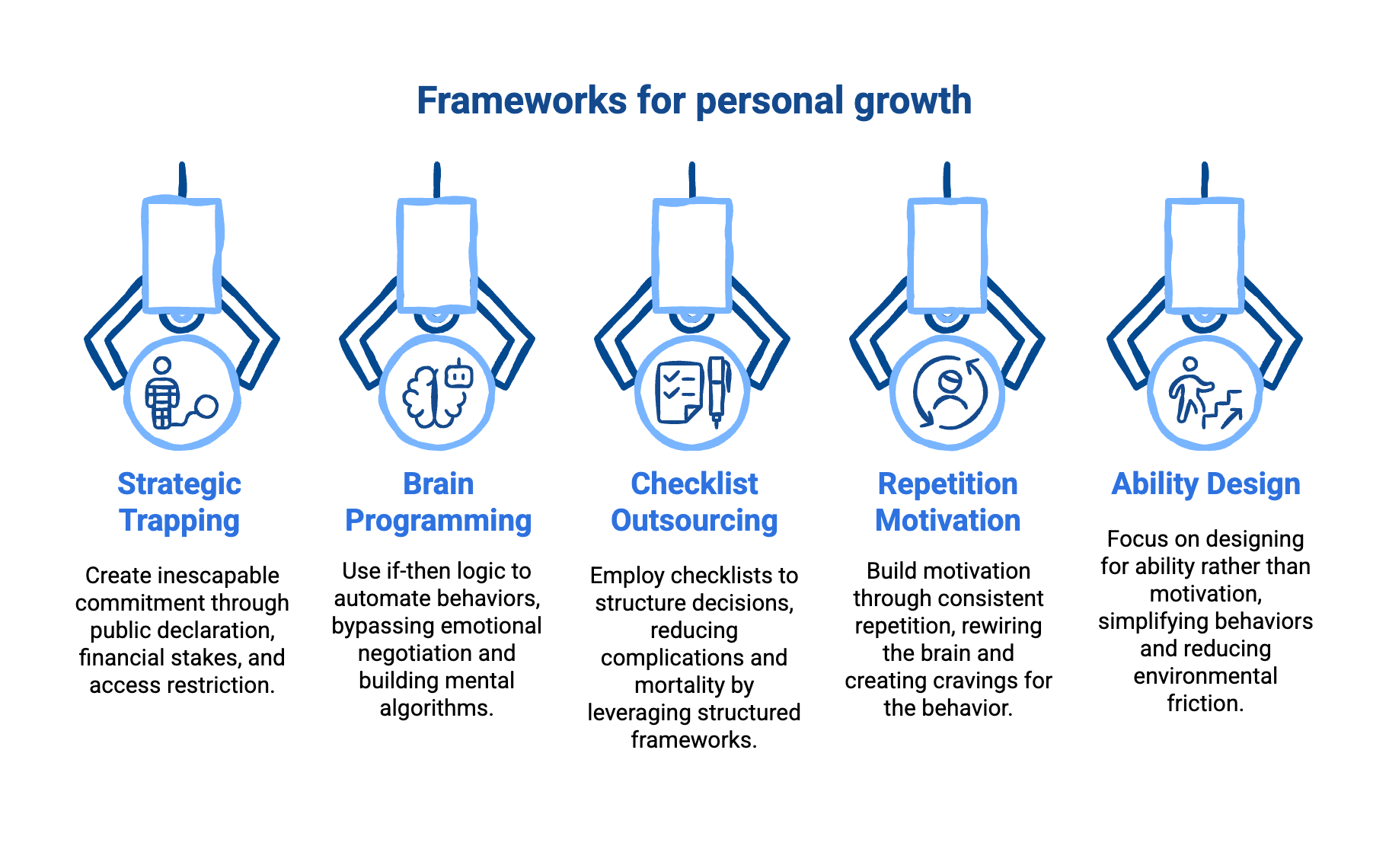
Framework 1: trap yourself strategically
The most effective commitment device is the one you can’t escape.
Public commitment works because social pressure creates accountability. Financial stakes work because you have skin in the game. Time boxing works because deadlines eliminate negotiation. Cutting access works because temptation never enters the equation.
These are forcing functions. Constraints that corner you into growth by removing retreat options.
Here’s the implementation:
Pick one goal. Make it public. Tell five people who will actually check on you. Not supportive friends who nod politely. People who will ask uncomfortable questions.
Add financial stakes. Put $100 on a commitment contract through a friend. If you miss your target, they donate it to a cause you hate. The asymmetry matters. Losing hurts more than winning feels good.
Cut access to your biggest temptation. Delete the app. Cancel the subscription. Give your credit card to someone else. Don’t test your willpower daily. Remove the option once.
Set a deadline that scares you slightly. Not impossible. Just uncomfortable. Book the presentation before you finish the slides. Schedule the race before you complete training. Commit before you’re ready.
This isn’t motivation. It’s architecture.
Framework 2: program your brain with if-then logic
Peter Gollwitzer’s research on implementation intentions demonstrated something remarkable. Vague goals fail at 62%. Specific if-then plans fail at 9%.
The difference? Specificity removes emotional negotiation.
“I want to exercise more” leaves room for debate every morning. Your brain questions whether today counts. Whether 10 minutes is enough. Whether you’re too tired.
“If it’s 6:00 AM on a weekday, then I put on running shoes and go outside for 20 minutes” eliminates the conversation. The condition triggers the action automatically.
This works because if-then planning creates mental algorithms that bypass conscious decision-making. When you encounter the cue, the response fires without emotional processing.
Create your algorithms:
Identify three behaviors you want to make automatic. Write them as if-then statements with specific triggers.
If I finish my morning coffee, then I open my writing document for 15 minutes.
If I feel stressed at 3:00 PM, then I walk outside for five minutes.
If I’m tempted to check social media, then I do 10 pushups first.
The cue must be specific and observable. The action must be simple and concrete. No vague intentions. No complex sequences. One trigger, one response.
Your nervous system will learn the pattern faster than you expect.
Framework 3: outsource decisions to checklists
Atul Gawande’s surgical safety checklist reduced complications by 36% and mortality by 47% across eight hospitals. Not through new technology. Not through better training. Through a one-page checklist.
The insight: even experts benefit from structured decision frameworks because expertise doesn’t protect against cognitive overload.
Implementation science research shows that eight factors determine checklist success. Preparation for change. Capacity for implementation. Appropriate strategies. Available resources. Clear leverage points. Enabling features. Built-in feedback. Sustainability planning.
Notice what’s missing from that list. Willpower. Motivation. Inspiration.
Design your checklists:
Create three categories. To-do lists for execution. To-want lists for expansion. To-be lists for identity.
Your morning to-do list contains five items maximum. Specific actions you can check off. Make bed. Drink water. Review priorities. Write for 20 minutes. Exercise for 15 minutes.
Your to-want list tracks aspirations. Skills you’re developing. Books you’re reading. People you want to connect with. Projects you’re exploring. This expands your future.
Your to-be list defines identity. Who you’re becoming. Character traits you’re building. Values you’re embodying. This grounds your choices.
Run your checklist at the same time daily. Morning works best. The pattern becomes automatic. The system runs itself.
Framework 4: let repetition build motivation
You’ve been told motivation creates action. The neuroscience suggests otherwise. Repetition creates motivation.
The striatum in your basal ganglia coordinates habit formation. As you repeat a behavior, activity shifts from your prefrontal cortex (planning) to your dorsolateral striatum (automatic movement). Research on pianists shows that those who reduce prefrontal activity faster acquire skills quicker.
Your brain literally rewires. Neurons that fire together wire together. The behavior becomes automatic. Then your nervous system starts craving the pattern itself.
This inverts the traditional wisdom. You don’t wait for motivation to act. You act repeatedly until your brain generates motivation automatically.
Build through repetition:
Choose one behavior. Make it stupidly small. Two minutes maximum. Do it at the exact same time every day for 30 days.
Don’t scale up yet. Don’t add complexity. Don’t test variations. Just repeat the identical action in the identical context.
Two minutes of writing at 6:00 AM. Two minutes of meditation at noon. Two minutes of reading before bed. The size matters less than the consistency.
Your brain will notice the pattern. Then strengthen it. Then start anticipating it. Then crave it. The motivation follows the action, not the other way around.
After 30 days, you can scale. Until then, just repeat.
Framework 5: design for ability, not motivation
B.J. Fogg’s behavior model shows that behavior occurs when three elements converge. Motivation. Ability. Prompt. Most people focus on motivation. Wrong target.
Ability is easier to change than motivation. Make the behavior simpler, and it happens more often. Research on waste-reduction apps showed 94.3% task completion when the design emphasized ability over motivation.
Your environment shapes your ability more than your willpower does. Two stairs between you and the gym matters. Ten minutes of commute matters. Friction kills behavior before motivation enters the equation.
Reduce friction systematically:
Map your target behavior. List every step required. Count them. Now remove half.
Want to exercise? Sleep in your workout clothes. Put shoes by the bed. Remove every decision between waking and starting. The behavior becomes easier. So it happens.
Want to eat better? Prep meals Sunday. Pack them in grab-and-go containers. Put healthy snacks at eye level. Hide junk food behind other items. You’re not resisting temptation. You’re designing around it.
Want to read more? Leave the book on your pillow. Put your phone in another room. Turn off notifications an hour before bed. The easier action wins by default.
Stop fighting friction. Engineer it out of the system.
Your implementation sequence
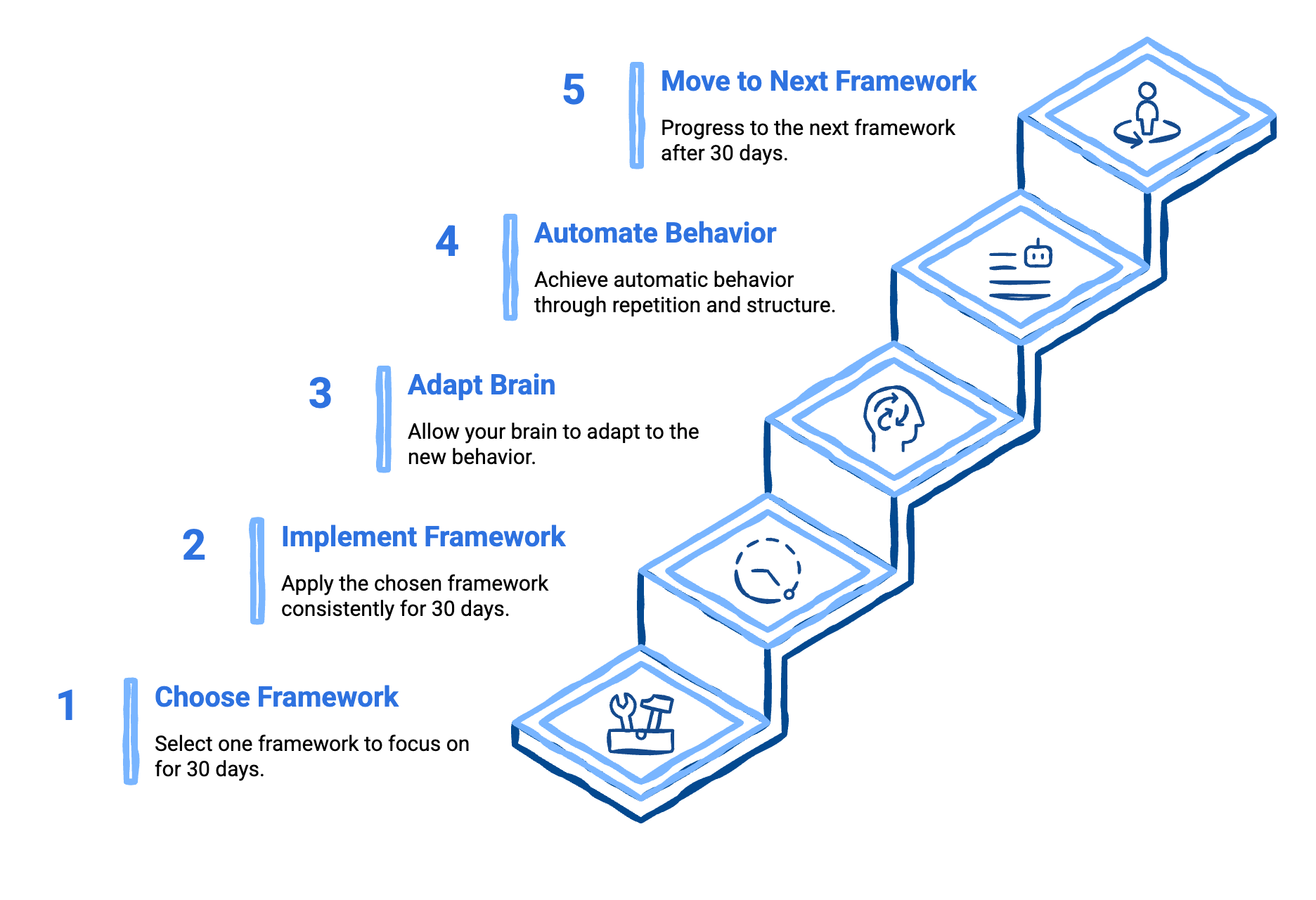
Here’s your starting point. Pick one framework. Not all five. One.
If you struggle with commitment, use forcing functions. Make it public, add stakes, set a deadline.
If you struggle with consistency, use if-then planning. Write three algorithms, test them for two weeks.
If you struggle with complexity, use checklists. Create your morning routine, follow it exactly.
If you struggle with motivation, use repetition. Pick one two-minute behavior, do it daily for 30 days.
If you struggle with friction, use ability design. Remove three obstacles from one target behavior.
Give yourself 30 days with one framework. Don’t switch. Don’t add. Don’t optimize. Just execute.
The system replaces the struggle. The automation replaces the effort. The structure replaces the motivation.
Your brain will adapt. Then the behavior becomes automatic. Then you move to the next framework.
The system runs itself
Traditional motivation advice tells you to dig deeper. Find your why. Visualize success. Push through resistance.
The research contradicts this. Systems beat motivation. Structure beats discipline. Design beats willpower.
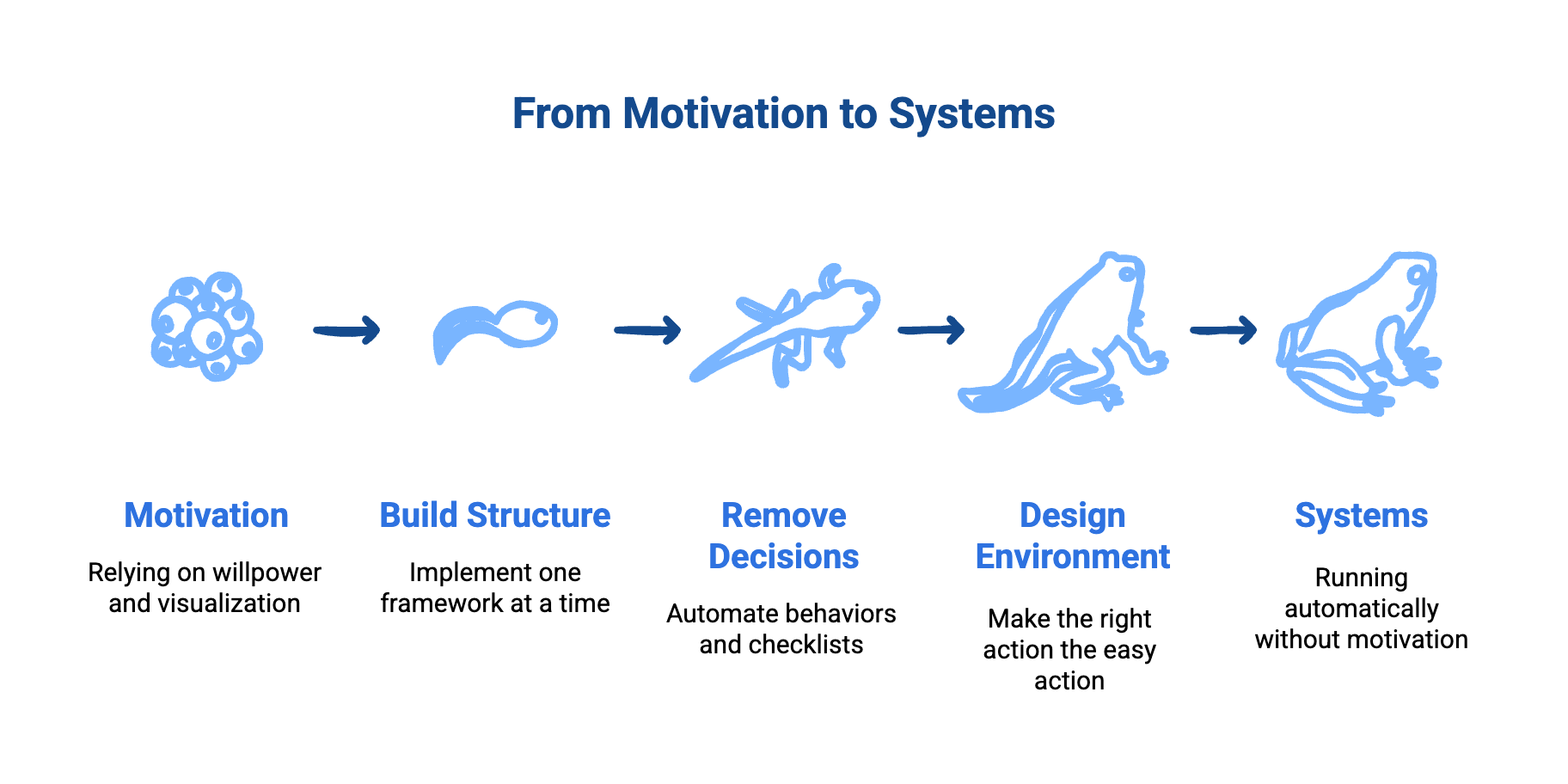
High performers don’t have more motivation than you. They built better systems. They removed decisions. They automated behaviors. They created environments where the right action becomes the easy action.
You can do the same. Start with one framework today. Build the structure. Let it run automatically. Add the next framework when you’re ready.
Your future self will thank you for building systems instead of relying on motivation that inevitably fades.
The question isn’t whether you feel motivated today. The question is whether your system works without you.
What’s the first framework you’ll implement?
Bonus resources
B.J. Fogg’s Behavior Model: The foundational framework for designing behavior change through ability, motivation, and prompts.
Implementation intentions research: Peter Gollwitzer’s original work on if-then planning and why specific plans dramatically outperform vague goals.
The neuroscience of habit formation: How the basal ganglia and striatum coordinate the shift from conscious behavior to automatic habits.
Jim, thank you for this great information! And I love the language that you used when writing it--not second grade English.
Thank you, Jim. I have been mulling why it's so hard for me to be consistent in waking up in the morning to exercise. Was faulting myself for being weak in discipline. But reading through this article and reflecting back- I think I need to fine-tune my system more and address all the excuses my mind throws at me as soon as the alarm clock goes off.