

Add 30% to your attention span without apps, courses, or willpower
The morning grid drill used in attention clinics, explained in plain terms


Hey Kwik Brains,
By the end of this article, you’ll know exactly what a Schulte table is, why it outperforms most cognitive training programs on transferable results, and how to build a 5-minute daily practice that produces measurable improvements in attention span and reading speed, with effects documented to last months after practice ends.
This isn’t about a new app or a wellness trend. It’s about a clinical diagnostic tool that turns out to be one of the most credibly transferable attention exercises in the peer-reviewed literature.

What a Schulte table is
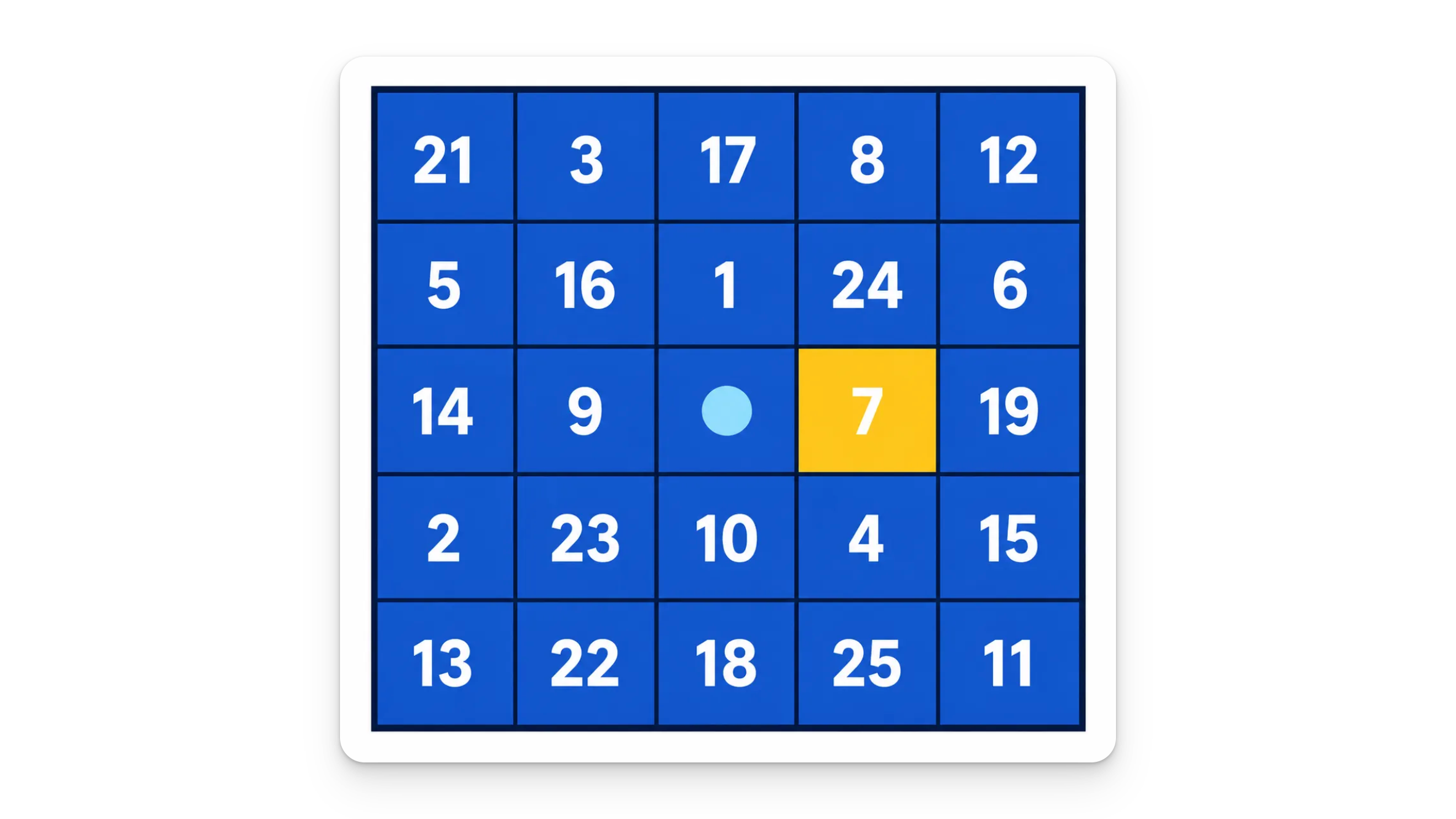
A Schulte table is a simple grid of numbers arranged in random order. The standard version is 5x5, containing numbers 1 through 25. The task: find and touch each number in sequence, starting from 1, as fast as possible.
Walter Schulte, a German psychiatrist, created the exercise as a clinical tool for diagnosing attention disorders. That was its original purpose. It remains in clinical use for ADHD assessment today.
What changed is what researchers found when people practiced it repeatedly instead of just being tested on it once.
The problem with most brain training
Before looking at Schulte table results, it’s worth understanding why most brain training research disappoints, because the Schulte table only makes sense in that context.
Most cognitive exercises have the same limitation: you get better at the task itself. The hoped-for transfer to daily performance, reading faster, focusing longer, processing information more quickly, rarely shows up in controlled conditions. A 2023 SAGE meta-analysis on cognitive training transfer effects reviewed dozens of controlled studies and reached a blunt conclusion: the true far-transfer effect size, measured against an active control group, is close to zero.
That’s the context that makes what follows worth paying attention to.
Why the Schulte table is a documented exception
The difference isn’t just statistical. It’s structural.
Most brain games train abstract cognitive operations that exist inside the game. The Schulte table trains peripheral vision and selective visual scanning, and those are not abstract at all. They are the same mechanisms you use every time you read a page, scan a screen, or process a document under time pressure.
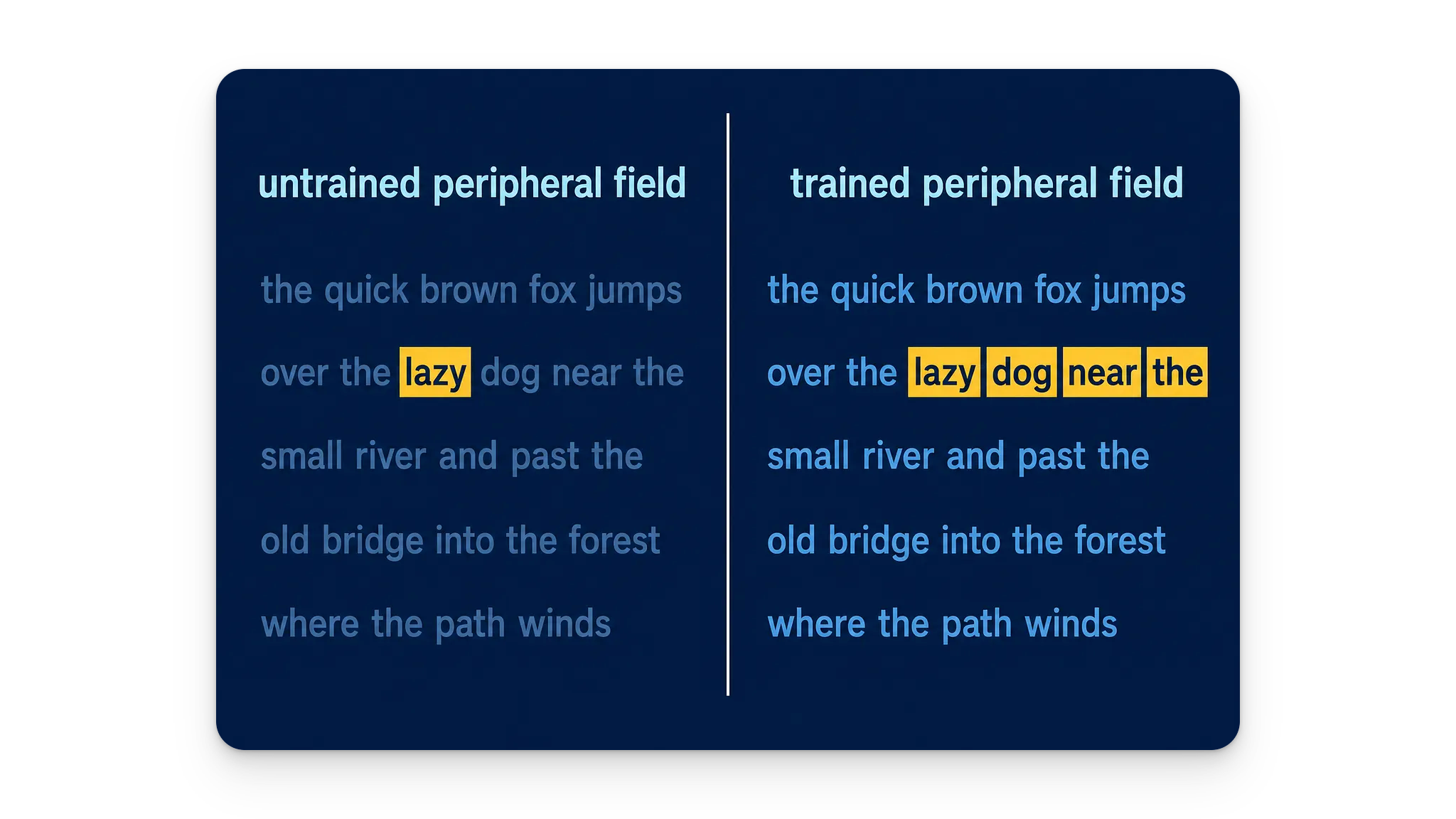
Skilled readers don’t move their eyes to every word individually. They use their peripheral field to pre-process upcoming text, reducing the number of eye fixations needed per line. The Schulte table directly trains that peripheral field by requiring you to find targets without moving your gaze toward them. The training task and the real-world application share the same neural pathway.
This structural overlap is why the transfer from Schulte training to reading and information-processing tasks is more credible here than in almost any other brief cognitive training protocol. You aren’t learning to play a game better. You are strengthening the same mechanism your brain uses to read.
What the research actually shows
The peer-reviewed data on Schulte table outcomes is specific and replicable:
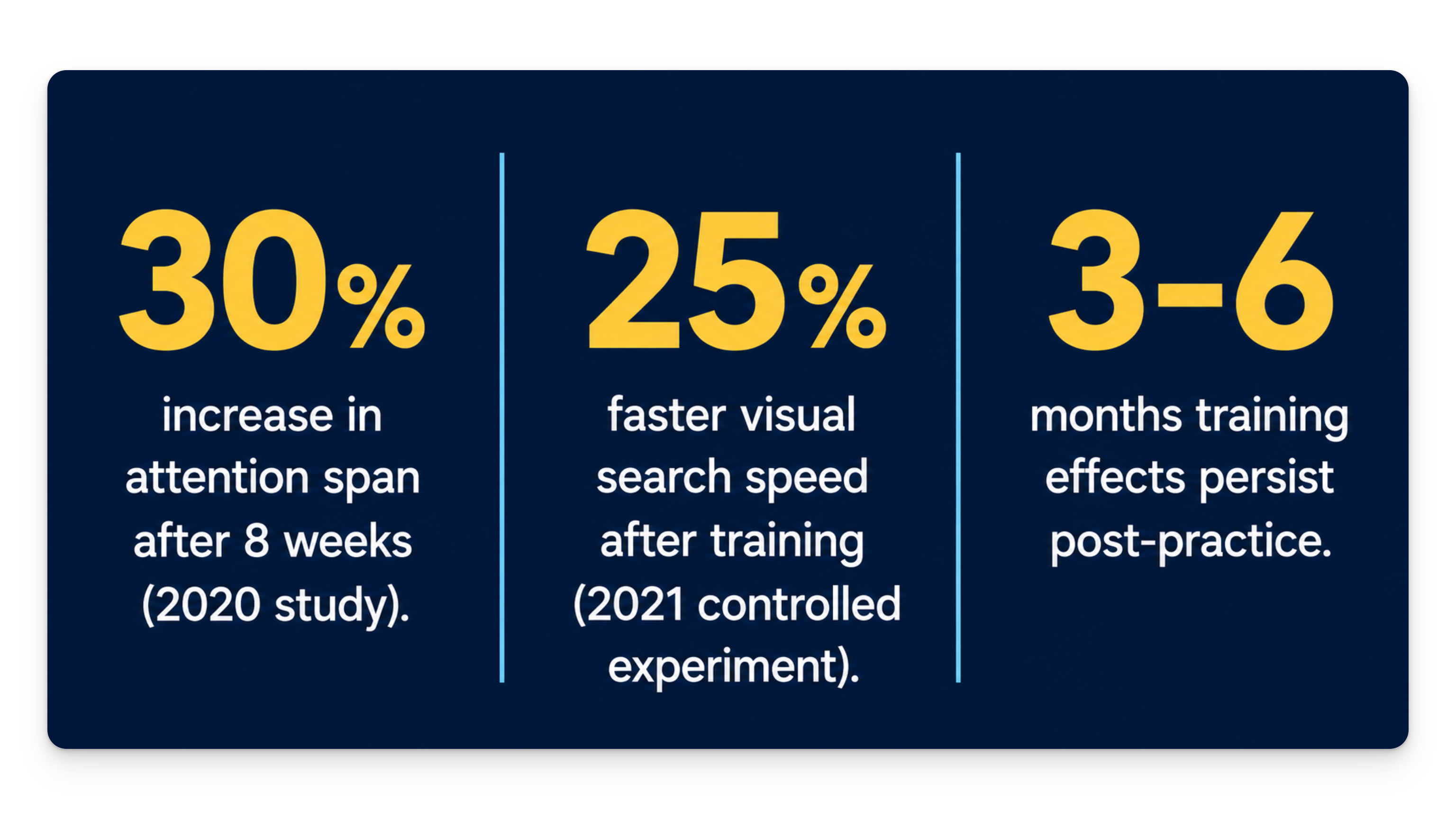
A 2020 study reported a 30% increase in attention span after 8 weeks of consistent daily training.
A 2021 controlled experiment found 25% faster visual search speed across participants.
Training effects persisted for 3 to 6 months after participants stopped practicing.
Gains hold across age groups. Children show the largest improvements. Adults still demonstrate around 25% improvement in visual processing speed on everyday tasks. The pattern replicates across different populations and controlled conditions, which is what separates this from single-study claims.
Who benefits most from this
The people who see the most practical return are those who process high volumes of text or visual information daily.
Professionals reading reports and market analysis, researchers scanning literature, developers reviewing code, executives moving through dense briefing documents, students working through reading-heavy coursework. If the bottleneck in your cognitive workday is the volume of information you have to move through, peripheral vision training addresses that bottleneck at the source.
This is not a general wellness practice. It’s a targeted tool for a specific, common problem.
How to practice: the daily protocol
The basic setup
Five minutes per day is the standard evidence-based recommendation. You need no software subscription or equipment. A free grid generator at schulte-table.org provides grids at all sizes with timed sessions.
The correct technique
This is where most people go wrong when starting out.
Keep your gaze fixed near the center of the grid. Do not track your eyes toward each number. Let your peripheral vision locate each target. If you scan the grid systematically instead, you train systematic scanning, not peripheral detection. The two feel similar but train entirely different things.
The discomfort of peripheral detection in the first few sessions is the signal that it’s working.
How to progress
Start with the 5x5 grid. When you consistently complete it in under 30 seconds, move to a 7x7 grid, then a 10x10. The progression is not optional. Staying comfortable at the same difficulty level removes the adaptation signal your brain needs to keep improving.
Benchmarks to track
Level Starting time Target time 5x5 grid 45 to 60 seconds Under 30 seconds 7x7 grid 90 to 120 seconds Under 60 seconds 10x10 grid 3 to 4 minutes Under 2 minutes
Record your completion time each session. Improvement shows up within the first two weeks at the 5x5 level.
The real bottleneck most people miss
Most people who struggle with focus treat it as a discipline problem. They try to concentrate harder, remove distractions, or restructure their schedules.
But when the visual field is narrow, information gets processed one unit at a time. That sequential processing drains attentional resources faster and limits reading speed at the input level. No discipline practice fixes an input-side limitation.
Training peripheral vision expands how much the brain processes in a single fixation. That changes the efficiency of the entire attention and reading system, not just performance on a grid.
The Schulte table was originally designed to identify what was broken in a patient’s attention system. The research finding is that the same tool repairs it.
Thanks Jim Kwik for teaching us how to use our brains - for good. Jose Ortega y Gassett said, "Tell me to what you pay attention, and I will tell you who you are." Your posts show us to make the most of our attention so we focus on who and what really matter, now not someday. - Sam Horn
Why is the number 20 missing from the grid?