

8 Study Methods That Build Real Memory (and 3 That Quietly Waste Your Time)
A simple breakdown of what works, what doesn't, and what to use when


Cramming feels like learning. It isn’t.
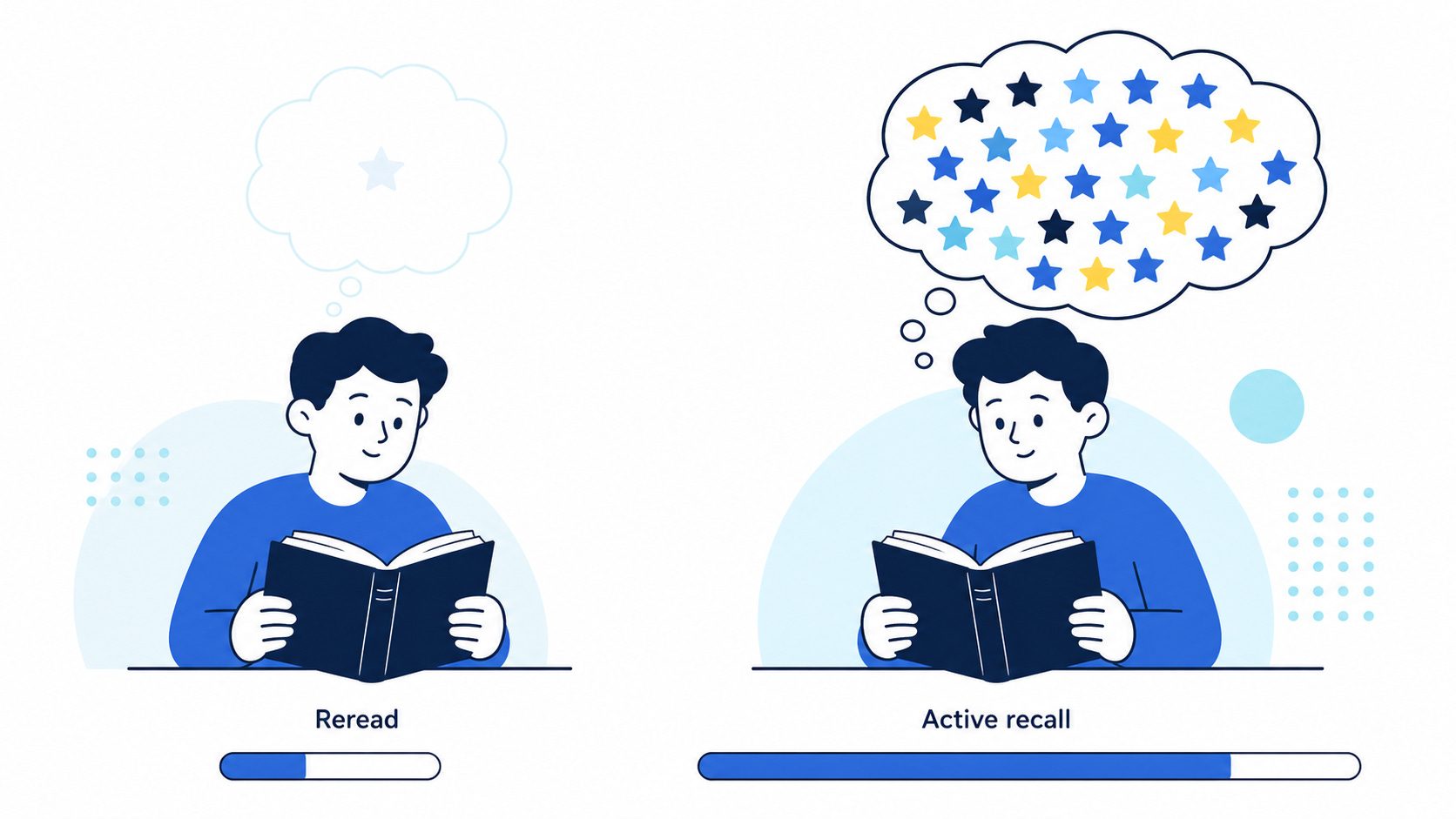
The science is direct here. Students who reread material forgot 56% of it within two days. Students who tested themselves on the same material forgot only 13%. Same time invested. Four times the retention.
The problem isn’t your brain. It’s your method.
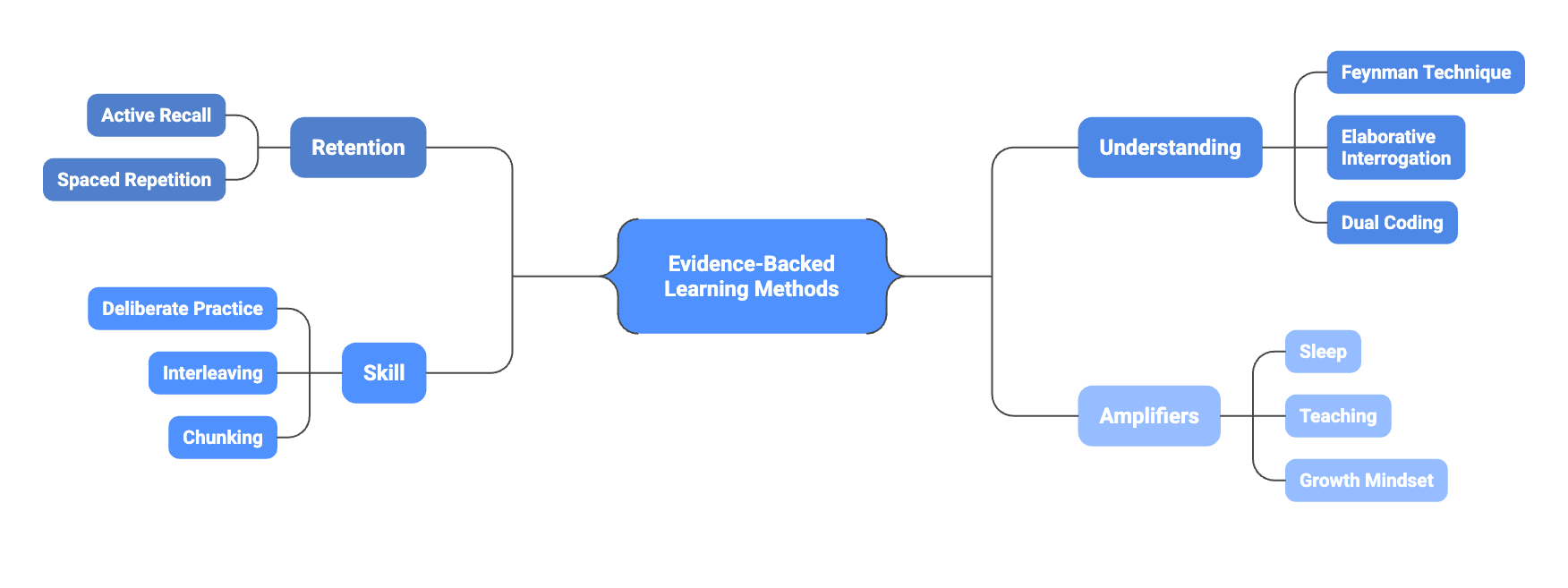
Most learning advice treats every situation the same way. That’s why study hours stop translating into competence. This newsletter is your reference for matching the technique to the task. Bookmark it. Come back to it. Pick the method, not the marathon.
The two methods you should default to
These two carry more evidence behind them than any other learning techniques in the published research. If you do nothing else, do these.
Active recall
Close the book. Reproduce what you just read, in your own words, on a blank page or out loud. Whatever’s missing or fuzzy is what you actually need to study. Whatever you got right is locked in tighter than it was 30 seconds ago.
This is the testing effect. The act of retrieving information rebuilds the memory trace. Passive review never does, no matter how many times you do it.
One rule changes the technique completely: if recall feels easy, you’re doing it too late. The harder the retrieval, the stronger the encoding.
Spaced repetition
Memory decays exponentially. Your brain dumps anything you don’t return to. Spaced repetition fights that by scheduling reviews at expanding intervals: 1 day, 3 days, 1 week, 2 weeks.
A 254-study review by Cepeda and colleagues found distributed practice beats massed practice for long-term retention across every subject they looked at. One study clocked 80% recall accuracy from spaced learners versus 60% from crammers.
Tools like Anki and Quizlet automate the intervals. The work is consistency, not invention.
Why these two stack
Active recall builds the memory trace. Spaced repetition keeps it from collapsing. Apart, each is powerful. Together, they’re the closest thing to a guaranteed learning system the research has produced.
🧠 Build this into a daily practice: Kwik Recall
If you want a structured way to put both methods into a daily habit, Kwik Recall is the 31-day memory training program built around active recall and the Five Levels of Learning. Twelve distinct memory skills, 15-20 minutes a day. If memory has been the weak link, this is the most direct path forward.
The understanding builders
Memorizing facts isn’t the same as understanding ideas. Three methods build the second one.
The Feynman technique
Pick a concept. Explain it in plain language as if you were teaching a 12-year-old. Wherever your explanation breaks down, that’s where your understanding actually breaks down. Return to the source, fill the gap, try again.
The method was the working habit of one of the most lucid physicists who ever lived. It works because jargon disguises confusion. Forcing yourself to drop the jargon strips the disguise.
Elaborative interrogation
For every new fact: ask why. Why is this true? Why would the opposite not be true? How does this connect to what I already know?
The brain stores answers more durably than statements. Generating causal explanations weaves new information into your existing knowledge web instead of leaving it floating as an isolated fact. Dunlosky’s landmark review rated this one high utility.
Dual coding
Pair words with images. Diagrams next to definitions. Sketchnotes alongside lecture notes. Concept maps for any complex idea.
The brain stores verbal and visual information in different systems. When you encode something both ways, you build two retrieval paths instead of one. Studies consistently show 80% retention with visual processing versus 40% with verbal alone, regardless of any “learning style” you think you have.
The “learning styles” theory, by the way, has been thoroughly debunked. Dual coding helps everyone.
The skill-building methods
If you’re learning to do something, not just to know it, these are the tools.
Deliberate practice
Routine repetition does not produce improvement. Deliberate practice does, and the difference matters.
Deliberate practice targets a specific weakness, operates at the edge of your current ability, requires immediate feedback, and is not fun. The discomfort is the mechanism, not a side effect.
This is the model behind elite musicians, surgeons, and athletes. Anders Ericsson’s 1993 paper in Psychological Review established that the elite weren’t just practicing more. They were practicing differently.
Interleaving
Mix different problem types within one study session. Don’t do all your algebra problems before starting geometry. Switch between them.
It feels harder. Performance during practice goes down. Long-term retention and transfer go up.
A 2022 study in Frontiers in Psychology confirmed interleaving across subjects produces the best learning outcomes by every measure that matters: retention, attention, cognitive load. Block practice gives you the illusion of mastery. Interleaving forces real discrimination between problem types.
Chunking
Working memory holds about 4-7 items at once. That’s it. Try to learn more than that simultaneously and you don’t, you just feel overwhelmed.
Chunking breaks complex material into smaller meaningful units, masters each, and then connects them. Don’t move forward until the current chunk is fluent. The temptation to cover more ground will cost you mastery every time.
The amplifiers nobody talks about
These don’t replace the methods above. They multiply them.
Sleep is part of the learning process
Encoding happens during waking hours. Consolidation happens during sleep. Skip the second and the first never sticks.
During slow-wave sleep, your hippocampus replays the day’s learning and transfers it to long-term storage in the cortex. Research synthesized in PNAS confirms sleep is not recovery from learning. It’s the second half of learning itself.
Studying for 90 minutes and then sleeping seven hours beats studying for nine hours and sleeping three. Every time.
Teaching beats studying
Tell yourself you’ll teach the material to someone else after you finish. Better, actually teach it. The Protégé Effect documents this consistently: students who prepared to teach outperformed students who prepared to be tested.
One catch from Nestojko’s 2014 research: it only works if you set the teaching intention before you study. Surprising someone with a teaching task afterward produces zero benefit.
Growth mindset is the operating belief
Carol Dweck’s 40 years of research is direct on this point: people who believe ability develops through effort and strategy show greater error-correction activity in the brain, and higher academic outcomes than people who treat ability as fixed.
Growth mindset is not unconditional praise. It includes honest assessment. The “false growth mindset,” as Dweck calls it, is praising effort without giving feedback on what to change. That actively reinforces ineffective strategies.

What to stop doing
These feel like learning. They aren’t.
Rereading. Highlighting. Watching the same lecture three times. Color-coding notes for hours. Labeling yourself a “visual learner” and avoiding the methods that don’t fit. All of these create the feeling of familiarity without building actual recall. That feeling is the trap.
Study hours don’t equal study results. Method choice does.
The decision rule: what to use when
When you’re learning a new topic, use this order.
First exposure: chunking + dual coding. Get a mental model in place.
Building understanding: Feynman technique + elaborative interrogation. Force the explanation, find the gaps.
Building retention: active recall + spaced repetition. Don’t reread, retrieve. Schedule reviews instead of cramming.
Building skill: deliberate practice + interleaving. Operate at the edge, mix problem types.
Amplifying everything: sleep on it, plan to teach it, treat ability as developable.
You don’t need every method. You need the right method for what you’re trying to do right now.

📚 Read faster, learn faster: Kwik Reading
Every method above assumes you can absorb material at a useful pace. Reading is the input layer for all of it. Kwik Reading triples reading speed and comprehension in 15 minutes a day for 3 weeks. Pair it with active recall and you stop being limited by how fast you can take new information in.
One question before you close this tab
Pick the next thing you want to learn. Now name the method you’re going to use, before you start.
Most learners never do this. That’s the difference.
What are you learning next, and which method will you use?
Bonus reading
Elaborative interrogation – Duke Academic Resource Center on the high-utility method most learners ignore.
Dual coding – Why pairing words and images outperforms either alone.
The Protégé Effect – TIME Magazine on the research showing why teaching makes you smarter.
Sleep and memory – Yale School of Medicine on consolidation as the hidden half of learning.
As an engineer, I see these study methods as a form of System Optimization. Passive review is like running a simulation without saving the data—it's a waste of computational energy. Active Recall and Spaced Repetition are the 'Write' and 'Refresh' commands for our biological hard drives. I also appreciate the emphasis on Dual Coding; in physics, we never separate the equation from the diagram because the brain needs both the symbolic and the spatial to achieve full resolution. This is a vital manual for anyone looking to upgrade their cognitive hardware.
😲😲😲